
- This topic is empty.
-
AuthorPosts
-
2026-05-18 at 4:36 pm #11460
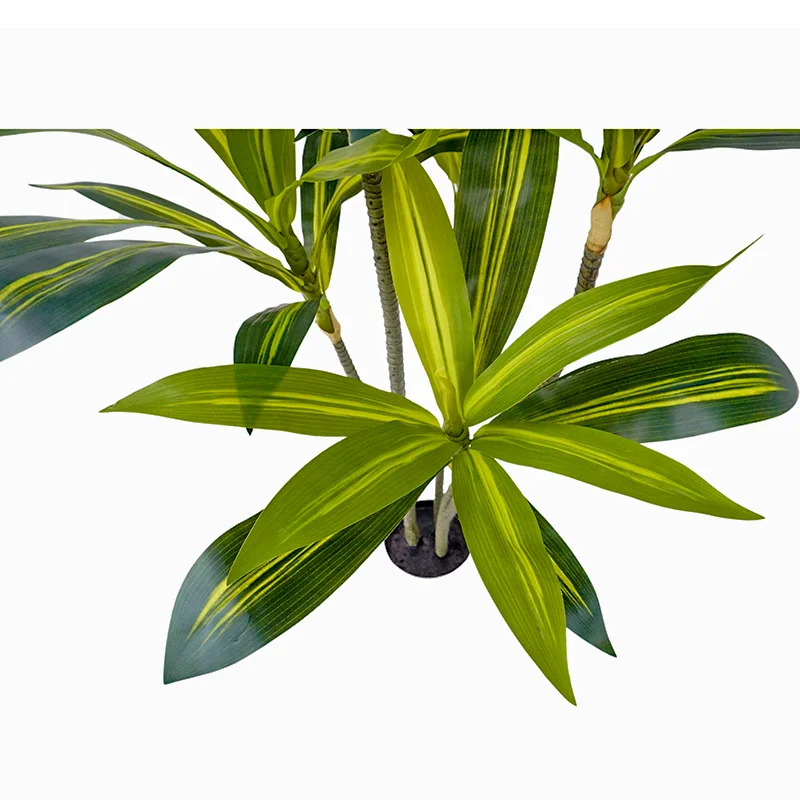
In large commercial landscaping projects, people often focus on whether an artificial plant “looks realistic.” But once projects scale into hundreds or thousands of units, the real challenge becomes something completely different: consistency.
This is especially noticeable with dracaena artificial plant systems used in:
-
Shopping malls
-
Hotels
-
Office atriums
-
Public infrastructure
-
Large indoor-outdoor mixed spaces
At small scale, slight variation between plants may not matter much. But in large deployments, even small differences in height, leaf density, or color tone become visually obvious very quickly.
That’s why large-scale artificial landscaping is increasingly becoming a manufacturing consistency problem rather than just a decoration problem.
For example, in multi-unit installations:
-
A 2–3 cm height variation can disrupt alignment
-
Slight pigment inconsistency becomes visible under natural lighting
-
Different stem stiffness between batches can create uneven posture across installations
When dozens of plants are positioned side by side, these issues become surprisingly noticeable.
One thing I find interesting is how much engineering actually goes into the internal structure of modern dracaena artificial plant systems.
Most commercial-grade products use reinforced internal cores made from:
-
Steel
-
Fiberglass
-
Reinforced polymers
The choice of core material directly affects long-term stability.
Steel-reinforced systems provide stronger rigidity for outdoor environments with wind exposure, while fiberglass structures offer better flexibility and fatigue resistance under repeated handling stress.
UV resistance is another area that’s often underestimated.
Outdoor artificial plants constantly face:
-
UV radiation
-
Temperature cycling
-
Moisture exposure
-
Surface oxidation
Without UV-stabilized polymers and controlled pigment systems, fading and surface degradation can happen relatively quickly — especially in tropical or high-irradiation environments.
That’s why commercial-grade systems increasingly rely on UV-resistant materials designed for multi-year outdoor deployment rather than purely decorative indoor use.
Installation efficiency also becomes a major issue in large projects.
Many newer dracaena artificial plant systems use modular structures to speed up deployment and reduce labor cost. But modularity introduces another challenge: maintaining structural stability at connection points over time.
Poorly designed interfaces can loosen after repeated movement or environmental stress, leading to leaning trunks or canopy misalignment.
Another thing worth discussing is environmental adaptability.
Modern commercial projects often combine:
-
Indoor atriums
-
Semi-outdoor corridors
-
Fully exposed outdoor areas
within the same visual design system.
That means manufacturers have to balance:
-
Realistic appearance under indoor lighting
-
UV durability outdoors
-
Structural rigidity
-
Long-term color consistency
across multiple environmental conditions simultaneously.
Companies such as Dongguan Ocean Harvest Arts & Crafts Co., Ltd. are increasingly approaching artificial plant production more like engineered product manufacturing rather than traditional decorative handicraft production.
And honestly, that shift makes sense.
At large commercial scale, success is no longer about how realistic one individual plant looks — it’s about whether thousands of units can maintain consistent appearance and structural performance over years of operation.
Curious whether others here working in commercial landscaping or architectural projects have run into similar consistency or durability challenges with large artificial plant deployments.
http://www.ohartsfauxplants.com
Dongguan Ocean Harvest Arts & Crafts Co., Ltd. -
-
AuthorPosts

- You must be logged in to reply to this topic.