
- This topic is empty.
-
AuthorPosts
-
2026-05-22 at 10:07 am #11515
In high-performance gear manufacturing, the demand for tighter tolerances, smoother transmission, and lower noise has made finishing processes increasingly critical. Among these, the worm grinding machine plays a central role in achieving the final geometry and surface quality required for modern gear systems.
Unlike conventional machining processes such as hobbing or shaping, worm grinding operates at the finishing stage, where micron-level precision directly determines gear performance. For industries such as automotive, robotics, aerospace, and industrial transmission, even slight deviations in tooth profile or lead can result in efficiency losses, vibration, and premature wear.
This article explores the technical principles, system architecture, and application-driven selection criteria of worm grinding machines, with a focus on how advanced CNC solutions enable consistent, high-precision gear production.
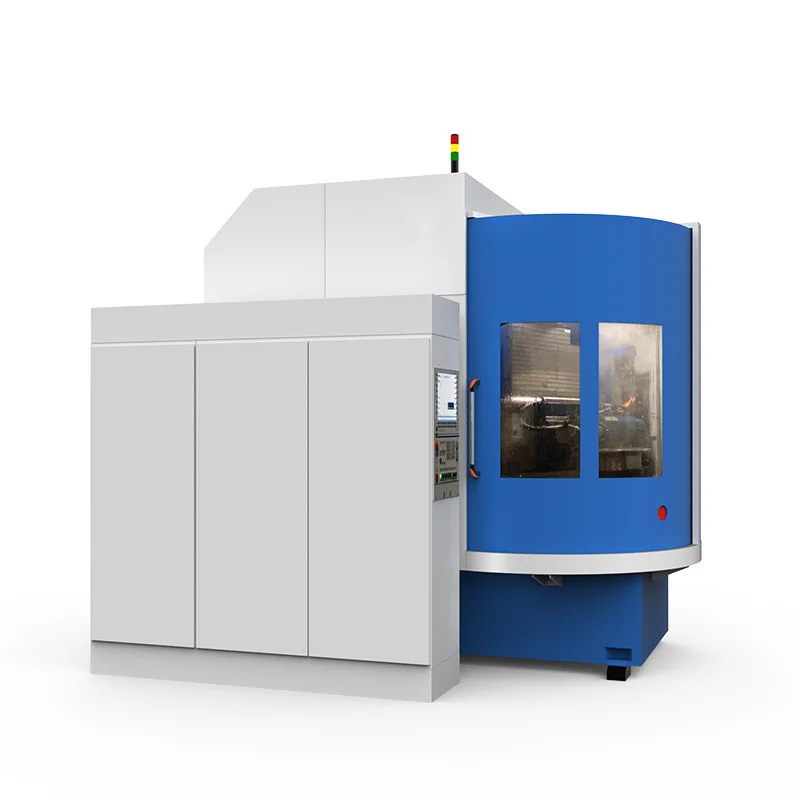
Why Worm Grinding Machine Is Critical in Gear Manufacturing
Gear production typically involves multiple stages: rough cutting, semi-finishing, and finishing. While processes like hobbing generate the basic tooth form, they cannot achieve the surface finish and geometric precision required for high-end applications.
The worm grinding machine is specifically designed to:
-
Achieve high-precision tooth profile and lead accuracy
-
Improve surface roughness to reduce friction and noise
-
Correct distortions caused by heat treatment
-
Ensure consistent gear meshing performance
In applications such as automotive transmissions or precision reducers, gear accuracy levels often need to meet DIN 5–6 or even higher standards, which can only be achieved through grinding processes.
Working Principle of a Worm Grinding Machine
The worm grinding process is based on the principle of generating grinding, where a grinding worm (a threaded abrasive tool) meshes with the gear in a controlled kinematic relationship.
Key characteristics of the process include:
-
Continuous generating motion between grinding worm and gear
-
Synchronization between rotational axes
-
Controlled material removal at micron-level increments
The grinding worm acts similarly to a hob, but instead of cutting, it removes material through abrasive action.
This method enables:
-
High efficiency compared to form grinding
-
Excellent consistency in mass production
-
Superior surface finish and geometric accuracy
Core System Architecture
A modern CNC worm grinding machine integrates multiple precision subsystems.
CNC Control System
The CNC system coordinates all axes with high precision, enabling complex grinding paths and compensation strategies.
Typical configurations include:
-
5-axis or 6-axis control systems
-
Real-time interpolation for synchronized motion
-
Automatic compensation for tool wear and thermal drift
Advanced CNC platforms support integration with gear design software, allowing direct import of gear parameters.
Grinding Spindle and Worm Tool
The grinding spindle must provide high rotational stability and minimal vibration.
Key parameters include:
-
Spindle speed: typically 1000–6000 rpm depending on application
-
Runout accuracy: < 2 μm
-
High rigidity to maintain consistent grinding pressure
The grinding worm is typically made of:
-
Vitrified bonded abrasives for high precision
-
CBN (cubic boron nitride) for high-efficiency grinding and long tool life
CBN tools are particularly effective for hardened gears due to their wear resistance and thermal stability.
Workpiece Clamping and Positioning
Accurate positioning of the gear blank is critical for achieving consistent results.
Modern systems use:
-
High-precision work spindles with rotary encoders
-
Hydraulic or pneumatic clamping systems
-
Automatic loading and unloading systems for mass production
Positioning accuracy directly affects tooth profile and lead precision.
Key Performance Parameters
Gear Accuracy and Surface Finish
The primary goal of worm grinding is to achieve high gear quality.
Typical results include:
-
Profile accuracy within ±2–5 μm
-
Lead accuracy within ±3–6 μm
-
Surface roughness (Ra): 0.4–0.8 μm
These parameters ensure smooth gear meshing and reduced noise.
Grinding Efficiency
Compared to other finishing methods, worm grinding offers high productivity.
Cycle time depends on:
-
Gear size and module
-
Material hardness
-
Grinding depth and feed rate
In high-volume production, optimized systems can achieve:
-
Cycle times of 30–120 seconds per gear
This makes worm grinding suitable for automotive-scale manufacturing.
Tool Life and Dressing Strategy
Grinding worm wear affects both accuracy and surface quality.
To maintain performance, machines incorporate:
-
Automatic dressing units
-
Adaptive dressing intervals based on usage
-
Real-time monitoring of grinding conditions
CBN tools can significantly extend tool life, reducing downtime and operational cost.
Comparison with Other Gear Grinding Methods
Worm Grinding vs Form Grinding
Form grinding uses a grinding wheel shaped to the gear tooth profile.
Advantages of worm grinding:
-
Higher efficiency for mass production
-
Continuous generating process
-
Better suited for standard gear geometries
Form grinding advantages:
-
Greater flexibility for complex or non-standard profiles
-
Higher precision for small batch production
Worm Grinding vs Honing
Gear honing is used for improving surface finish after grinding.
Compared to honing, worm grinding:
-
Removes more material
-
Corrects geometric errors
-
Achieves higher overall accuracy
Honing is typically used as a secondary finishing step.
Application Scenarios
The worm grinding machine is widely used in industries requiring high-precision gears.
In automotive manufacturing, it is essential for transmission gears, differential gears, and EV drivetrain components.
In robotics and automation, it supports precision reducers and servo gear systems.
In aerospace, it ensures high reliability and low noise in critical gear assemblies.
In industrial machinery, it is used for high-load and high-speed transmission systems.
Each application requires specific optimization of grinding parameters and machine configuration.
Integration with Complete Gear Production Lines
Modern gear manufacturing increasingly relies on integrated production systems.
A worm grinding machine is typically part of a larger workflow that includes:
-
CNC hobbing machines for initial tooth cutting
-
Heat treatment systems for hardness
-
Gear grinding machines for finishing
-
Gear measurement centers for quality inspection
Manufacturers like Wuxi General Machinery Co., Ltd. provide complete gear processing solutions, combining multiple CNC machines into a cohesive production line.
This integration ensures:
-
Consistent quality across all stages
-
Reduced handling and setup time
-
Improved production efficiency
Automation and Smart Manufacturing
Automation is transforming the operation of worm grinding machines.
Key developments include:
-
Robotic loading and unloading systems
-
Inline measurement and feedback control
-
Integration with MES (Manufacturing Execution Systems)
-
Predictive maintenance based on sensor data
These technologies enable unmanned operation and improve overall productivity.
Common Challenges and Engineering Solutions
Thermal Deformation
Heat generated during grinding can affect accuracy.
Solutions include:
-
Advanced cooling systems
-
Thermal compensation algorithms
-
Stable machine structure design
Vibration and Stability
Vibration can degrade surface finish and accuracy.
Solutions include:
-
High-rigidity machine frames
-
Precision spindle design
-
Dynamic balancing of rotating components
Tool Wear Management
Inconsistent tool wear leads to quality variation.
Solutions include:
-
Automated dressing systems
-
Real-time monitoring of grinding forces
-
Use of high-quality abrasive materials
Cost Efficiency and ROI Considerations
While worm grinding machines require significant investment, their value lies in long-term performance.
Benefits include:
-
Reduced scrap rates due to higher accuracy
-
Lower noise and improved product quality
-
High throughput for mass production
-
Reduced post-processing requirements
In large-scale manufacturing, these factors lead to lower cost per unit and faster return on investment.
Future Trends in Worm Grinding Technology
The evolution of worm grinding machines is driven by increasing precision requirements and digitalization.
Key trends include:
-
AI-based process optimization
-
Digital twin simulation for process planning
-
Higher-speed grinding with advanced abrasives
-
Integration with additive manufacturing workflows
These innovations are pushing the limits of gear manufacturing precision and efficiency.
Worm Grinding Machine: A Foundation for High-Precision Gear Production
The worm grinding machine is a critical component in modern gear manufacturing, enabling the precision, efficiency, and consistency required for advanced mechanical systems.
By combining high-performance CNC control, advanced grinding tools, and integrated production solutions, it delivers the accuracy needed for demanding applications.
For manufacturers aiming to achieve superior gear quality and scalable production, investing in a well-engineered worm grinding machine is not just an upgrade—it is a strategic necessity for long-term competitiveness.
http://www.gltmachinery.com
Wuxi General Machinery Co., Ltd. -
-
AuthorPosts

- You must be logged in to reply to this topic.