
- This topic is empty.
-
AuthorPosts
-
2026-06-09 at 2:43 pm #11680
The rapid expansion of intelligent self-service terminals—from automated parcel lockers and vending machines to EV charging stations—has created unprecedented demands for reliable, high-speed connectivity. As these unattended devices proliferate across urban and remote environments, traditional networking solutions increasingly struggle to deliver the stability, bandwidth, and security required for seamless 24/7 operations. The emergence of industrial 5G routers represents a fundamental shift in how businesses approach connectivity for distributed self-service infrastructure.
The Connectivity Crisis in Self-Service Deployments
Intelligent self-service terminals face unique operational challenges that differentiate them from conventional IoT applications. These devices must process real-time transactions, stream high-definition surveillance footage, and maintain constant cloud synchronization—often in environments with extreme temperatures, electromagnetic interference, and limited physical access for maintenance. Industry data reveals that 68% of industrial IoT projects encounter serious connectivity failures, with network instability cited as the primary cause of equipment downtime.
Traditional consumer-grade routers repurposed for commercial use frequently fail under these demanding conditions. Temperature fluctuations cause component degradation, leading to spontaneous reboots during peak transaction periods. Generic firmware vulnerabilities expose payment systems to security breaches, while inadequate failover mechanisms result in costly service interruptions. For operators managing thousands of terminals across multiple regions, these connectivity failures translate directly into lost revenue, damaged brand reputation, and escalating maintenance costs.
Industrial-Grade Architecture: The Foundation of Reliability
The technical specifications that distinguish genuine industrial 5G routers from consumer alternatives directly address these operational pain points. At the component level, industrial routers employ chipsets and circuit boards designed for extended temperature ranges—typically -35°C to +75°C—ensuring consistent performance in unheated outdoor kiosks during winter and non-air-conditioned enclosures in summer heat. Advanced electrostatic discharge (ESD) protection rated at 15KV shields payment processing circuits from the electromagnetic interference common in retail and transportation environments.
E-Lins Technology has engineered its H900f Gigabit 5G Industrial Router specifically for high-bandwidth self-service applications. The device achieves gigabit-level peak transmission rates, enabling simultaneous 4K video surveillance streaming, real-time inventory management, and instantaneous payment authorization without latency-induced transaction failures. The dual SIM hot backup configuration ensures uninterrupted connectivity through automatic failover switching within seconds, maintaining an equipment online rate of 99.5% or higher across deployed installations.
This reliability stems from comprehensive system integration rather than isolated component upgrades. The router’s independently developed firmware—optimized over 20 years of wireless communication specialization—eliminates the bloat and security vulnerabilities inherent in repurposed consumer operating systems. Hardware watchdog timers automatically detect and recover from system freezes without human intervention, while link self-healing mechanisms maintain connections through temporary network disruptions.
Deployment Efficiency and Total Cost of Ownership
Beyond reliability metrics, industrial 5G routers deliver measurable economic advantages through streamlined deployment and reduced maintenance overhead. The modular interface design of solutions like the H900 series—featuring five Gigabit Ethernet ports alongside serial RS232/RS485 connections—enables single-device integration for terminals requiring simultaneous connectivity for payment processors, surveillance cameras, environmental sensors, and digital signage displays. This consolidation eliminates the complexity and failure points associated with multi-router configurations.
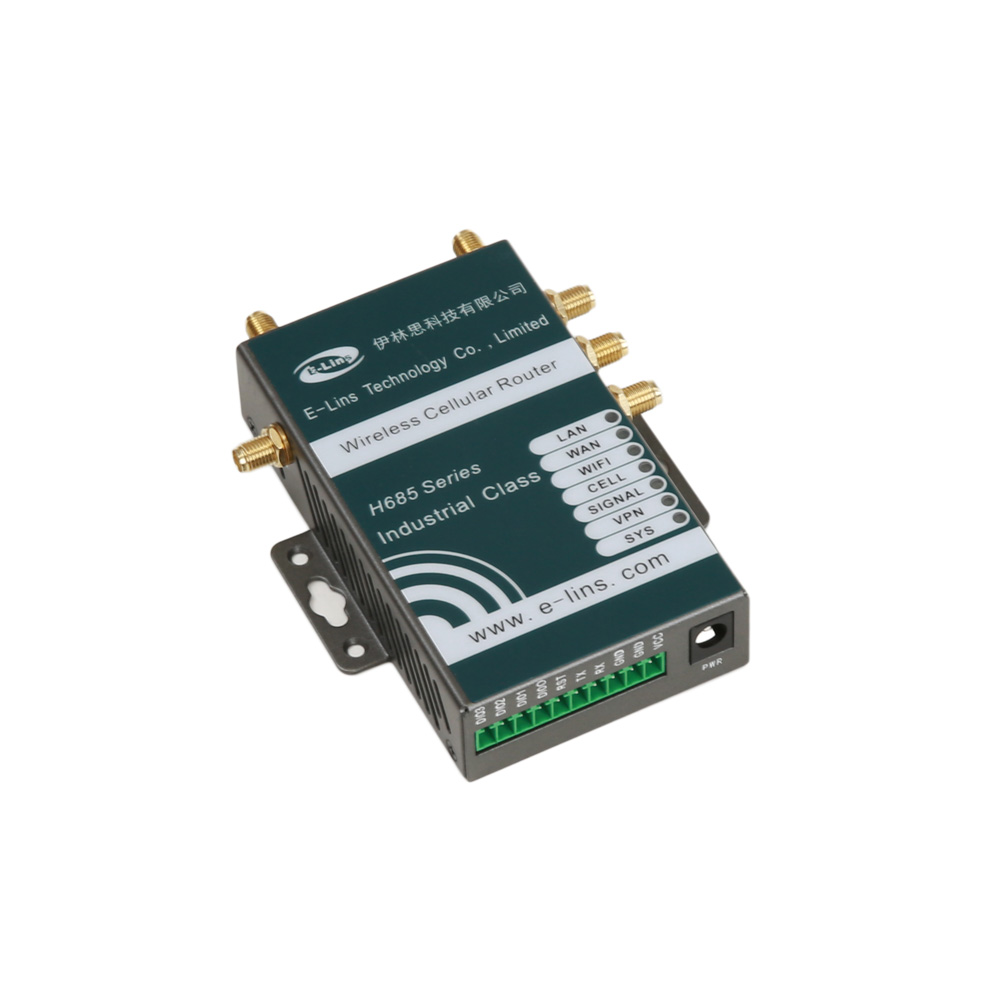
PoE++ (Power over Ethernet Plus) support further simplifies installation by delivering both data connectivity and electrical power through standard Ethernet cabling. For parcel locker operators deploying units in subway stations or apartment building lobbies, this capability reduces installation costs by approximately 40% while improving physical security through the elimination of vulnerable external power connections. The compact form factor of embedded variants like the H685f series—measuring just 100×60×21mm—enables concealed integration within terminal chassis, addressing space constraints while protecting equipment from tampering.
Remote management capabilities fundamentally transform operational economics for multi-site deployments. Centralized platforms supporting TR-069, SNMP, and SSH protocols enable technicians to perform firmware updates, configuration changes, and diagnostic packet captures across thousands of terminals from a single console. E-Lins Technology reports that 90% of technical issues are resolved remotely through these management tools, reducing on-site maintenance costs by 68% compared to traditional touch-based troubleshooting approaches.
Security Architecture for Financial Transactions
Self-service terminals processing financial transactions require security standards that match or exceed traditional point-of-sale systems. Industrial 5G routers address this imperative through multiple architectural layers. Enterprise-grade VPN protocol support—including WireGuard, IPsec, and OpenVPN—establishes encrypted tunnels that protect payment data from interception during wireless transmission. WireGuard implementation in particular offers significant advantages, combining military-grade encryption with minimal processing overhead that preserves bandwidth for transaction throughput.
Physical security measures complement cryptographic protections. The electromagnetic isolation rated at 1.5KV prevents signal leakage that could enable eavesdropping on wireless communications, while tamper-evident enclosures and secure boot mechanisms protect against physical compromise of router firmware. For gaming terminal operators and ATM networks where transaction integrity directly impacts regulatory compliance, these security features have proven essential—one South American gaming equipment manufacturer achieved 99.9% data transmission success rates and zero accounting disputes across 25,000 terminals following migration to industrial router infrastructure.
Real-World Performance Validation
Deployment outcomes across diverse operational environments provide empirical validation of industrial 5G router capabilities. In Nordic intelligent transportation implementations, where electronic bus stop displays and in-vehicle networking systems must function reliably through winters reaching -32°C, E-Lins Technology routers reduced network interruption rates to 0.3% while decreasing information screen blackout duration by 96%. The remote fault resolution capability enabled transit authorities to reduce maintenance personnel from 25 technicians to 7, generating annual savings of approximately $1.18 million.
European airport ground support equipment (GSE) presents another demanding use case, with electromagnetic interference from aircraft systems and exposure to extreme weather conditions on open tarmacs. A renowned GSE manufacturer serving airports in over 100 countries achieved equipment online rates exceeding 99.9% after standardizing on industrial 4G/5G routers with VPN connectivity, with 85% of technical issues now resolved remotely rather than requiring airport-side technician dispatch.
For Indian telecom infrastructure deployed in regions with unstable power grids fluctuating between 5V and 55V and ambient temperatures reaching 48°C, carrier-grade industrial routers have maintained 99.4% equipment online rates across 100,000 units while reducing per-site maintenance costs by 53%. These outcomes demonstrate that genuine industrial-grade hardware delivers measurable return on investment through reduced downtime and operational overhead, typically offsetting higher initial equipment costs within the first year of deployment.
Strategic Considerations for Self-Service Network Architecture
Organizations planning self-service terminal deployments should evaluate connectivity solutions against several critical criteria. Temperature tolerance specifications must match actual installation environment conditions rather than idealized indoor assumptions. Dual SIM capability with intelligent load balancing provides essential redundancy for revenue-critical applications, while carrier-agnostic hardware design preserves flexibility as telecommunications markets evolve.
Long-term total cost of ownership calculations should incorporate remote management capabilities, firmware upgrade pathways, and manufacturer support responsiveness. Solutions from manufacturers with demonstrated expertise in industrial wireless communications—evidenced by carrier-grade project validation and sustained production volumes—offer greater assurance of continued support compared to consumer electronics vendors experimenting with commercial applications.
The transition to 5G connectivity introduces new architectural possibilities beyond simple bandwidth increases. Network slicing capabilities enable dedicated virtual networks with guaranteed quality of service for transaction processing, while ultra-low latency facilitates emerging applications like real-time video consultation from self-service terminals. Multi-gigabit interfaces support edge computing deployments that process surveillance footage and customer analytics locally, reducing cloud transmission costs while improving response times.
Conclusion
Industrial 5G routers have evolved from niche telecommunications infrastructure into mission-critical enablers of the self-service economy. The technical distinctions separating genuine industrial-grade solutions from repurposed consumer equipment—wide temperature tolerance, independent firmware development, redundant connectivity architectures, and comprehensive security implementations—directly translate into operational reliability, reduced maintenance costs, and enhanced security posture. As intelligent self-service terminals expand into increasingly demanding environments and handle more sophisticated applications, the network infrastructure supporting them must provide corresponding levels of performance and dependability. Organizations that prioritize proven industrial connectivity solutions position themselves to capitalize on the self-service transformation while avoiding the costly downtime and security vulnerabilities that plague inadequate network implementations.
https://e-lins.com/
Shenzhen E-Lins Technology Co., Ltd. -
AuthorPosts

- You must be logged in to reply to this topic.