
- This topic is empty.
-
AuthorPosts
-
2026-06-10 at 6:17 pm #11691
When industrial projects demand fasteners that won’t fail under extreme loads, metric class 10.9 hex flange nuts emerge as the backbone of reliable assembly systems. These precision-engineered components bridge the gap between standard hardware and mission-critical applications where vibration resistance, load distribution, and mechanical integrity determine project success or catastrophic failure.
Understanding Metric Class 10.9: The Strength Standard
The metric class 10.9 designation reveals critical performance characteristics through its numerical coding system. The first digit (10) indicates tensile strength measured in hundreds of megapascals—translating to a minimum tensile strength of 1,000 MPa. The second digit (9) represents the ratio between yield strength and tensile strength, meaning these fasteners achieve 90% yield strength relative to their ultimate tensile capacity. This combination delivers a yield strength of approximately 900 MPa, positioning class 10.9 nuts among high-strength fastening solutions capable of withstanding substantial mechanical stress without permanent deformation.
This strength classification proves essential in applications where joint failure carries severe consequences. Construction equipment subjected to constant vibration, structural steel connections in infrastructure projects, and automotive chassis assemblies all require fasteners that maintain integrity under cyclic loading and environmental exposure.
Hex Flange Design: Engineering Function Meets Practical Advantage
The integrated flange design distinguishes these nuts from conventional hex nuts through a critical functional enhancement. The flange acts as a built-in washer, creating an expanded bearing surface that distributes clamping force across a larger contact area. This geometric feature delivers three operational benefits that directly address common assembly challenges.
First, the increased bearing surface reduces contact stress on substrate materials, preventing crushing or deformation of softer metals, composites, or coated surfaces. Second, the flange’s serrations or knurled underside create friction that resists rotational loosening caused by vibration—a persistent problem in mobile equipment and machinery. Third, eliminating the separate washer component streamlines assembly processes, reducing part count and installation time while preventing washer loss or misalignment during field operations.
Material Specifications and Heat Treatment Requirements
Metric class 10.9 hex flange nuts typically utilize medium carbon steel or alloy steel substrates that achieve specified mechanical properties through controlled heat treatment processes. The manufacturing sequence involves cold forming or hot forging the base geometry, followed by quenching and tempering cycles that develop the crystalline structure necessary for high strength and adequate ductility.
Material selection balances multiple performance factors. Carbon content typically ranges between 0.25% and 0.55%, providing hardenability while maintaining weldability in certain applications. Alloying elements such as chromium, manganese, and boron enhance through-hardening characteristics, ensuring consistent mechanical properties across the nut’s cross-section rather than merely surface hardness.
Quality manufacturing protocols include verification testing where sample nuts undergo tensile testing, proof load testing, and hardness verification to confirm compliance with ISO 898-2 standards governing metric fastener mechanical properties.
Dimensional Standards and Thread Specifications
Hex flange nuts conforming to class 10.9 specifications follow standardized dimensions defined by ISO 4161 or DIN 6923, ensuring interchangeability across manufacturers and compatibility with metric bolts. Critical dimensions include across-flats measurements (the hexagonal wrench engagement dimension), overall height, flange diameter, and flange thickness.
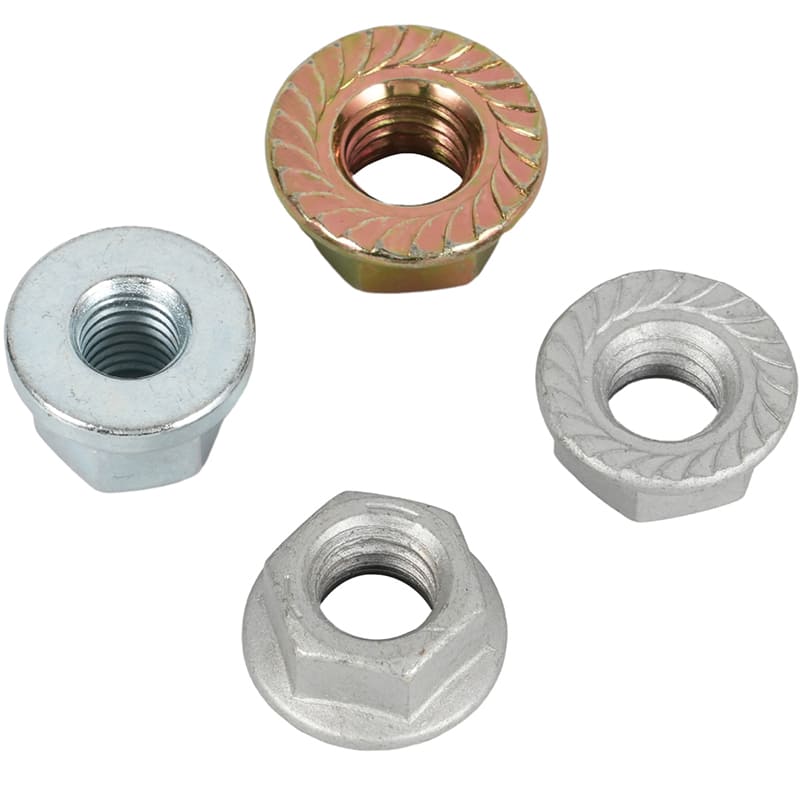
Thread specifications follow ISO metric coarse or fine pitch standards, with internal threads manufactured to 6H tolerance class—providing sufficient clearance for assembly while maintaining adequate thread engagement. The pitch diameter, major diameter, and minor diameter must fall within specified tolerance bands to ensure proper mating with class 8.8, 10.9, or 12.9 bolts.
Flange dimensions typically extend the effective bearing diameter to 1.5 to 2 times the nominal thread diameter, significantly increasing load distribution compared to standard hex nuts. Flange thickness and underside features vary by manufacturer but must maintain structural integrity under specified proof loads without cracking or permanent deformation.
Coating Systems for Corrosion Protection
While class 10.9 designates mechanical strength, corrosion resistance requires additional surface treatment tailored to environmental exposure conditions. Zinc plating provides economical protection for indoor or mildly corrosive environments, typically achieving 200-500 hours of salt spray resistance per ASTM B117 testing protocols.
For infrastructure projects facing decades of outdoor exposure, advanced coating systems deliver superior protection. Zinc-nickel (Zn-Ni) coatings achieve 1,000+ hours of salt spray resistance, making them suitable for highway guardrail systems and bridge construction. Geomet and Magni coatings—thin, inorganic zinc-aluminum flake systems—provide exceptional performance in marine environments and coastal installations, with documented service lives exceeding 20 years in high-chloride conditions.
Hot-dip galvanizing offers maximum coating thickness and mechanical durability, though the thermal process requires careful hydrogen embrittlement control procedures for high-strength fasteners. Proper baking cycles following any electroplating or pickling operation prove critical for class 10.9 components, as absorbed hydrogen can cause delayed brittle fracture under sustained loads.
Shanghai Hengrui Industry Co., Ltd. has established expertise in coating selection for critical applications, having supplied specialty-coated fasteners for solar mounting systems across North America where 25-year service life requirements demand coating systems that outlast conventional zinc plating by orders of magnitude.
Application Considerations and Torque Requirements
Proper installation of metric class 10.9 hex flange nuts requires attention to torque specifications that balance adequate preload against the risk of thread stripping or fastener yielding. Torque values depend on thread size, lubrication conditions, and the strength grade of the mating bolt. As a general guideline, class 10.9 nuts paired with class 10.9 bolts can safely achieve 75-80% of the bolt’s proof load when proper installation practices are followed.
The flange design influences torque-tension relationships by modifying friction coefficients compared to nut-plus-washer assemblies. Installation procedures should account for the flange’s anti-rotation features, which may require slightly higher breakaway torque during disassembly operations.
In vibration-prone applications such as automotive suspension systems or industrial machinery, supplementary locking methods may complement the flange’s inherent resistance. Thread-locking compounds, secondary locking nuts, or mechanical locking features provide additional security where fastener loosening presents safety risks.
Quality Verification and Traceability
Professional fastener suppliers maintain rigorous quality control systems that verify mechanical properties, dimensional accuracy, and coating performance through statistical sampling and batch testing. ISO 9001:2015 certification provides framework assurance, but specification compliance requires testing infrastructure including tensile testers, hardness testers, coating thickness gauges, and salt spray chambers.
Traceability systems linking production batches to raw material certifications and heat treatment records enable root cause analysis if field failures occur. Reputable manufacturers mark fasteners with identification codes or brand marks—Shanghai Hengrui Industry’s "HR" mark serves this traceability function while signifying quality verification.
Sourcing Considerations for Critical Applications
When project specifications call for metric class 10.9 hex flange nuts in demanding applications, supplier selection proves as critical as the fastener specification itself. Technical expertise in material science, coating selection, and application engineering separates commodity distributors from specialized manufacturers capable of supporting complex requirements.
Shanghai Hengrui Industry Co., Ltd. brings 16+ years of fastener industry expertise to infrastructure and industrial projects, with particular strength in custom coating specifications and rapid sampling for pre-production verification. The company’s 24-hour quotation response and technical consultation services address the procurement challenges that delay projects when non-standard specifications or performance verification documentation are required.
With annual production capacity reaching 12,000 tons and ISO 9001:2015 certified quality systems, Hengrui Fastener serves EPC contractors, OEM buyers, and project managers across renewable energy, infrastructure construction, and heavy machinery sectors where fastener failure carries unacceptable consequences.
Conclusion: Precision Engineering for Reliable Connections
Metric class 10.9 hex flange nuts represent the intersection of metallurgical science, precision manufacturing, and application-specific engineering. Understanding their specifications—from strength classifications and heat treatment requirements to coating selection and installation parameters—enables informed procurement decisions that prevent costly field failures and ensure long-term mechanical integrity in demanding industrial environments.
Shanghai Hengrui Industrial Co., Ltd -
AuthorPosts

- You must be logged in to reply to this topic.