
- This topic is empty.
-
AuthorPosts
-
2026-07-07 at 2:08 pm #11914
Rubber-to-metal bonding is one of the most demanding processes in industrial manufacturing. Unlike bonding similar materials, engineers must join two substrates with completely different physical properties. Rubber is flexible, elastic, and constantly changing shape under load, while metal is rigid and dimensionally stable. Every vibration, temperature change, and mechanical cycle places stress directly on the adhesive interface.
For this reason, successful bonding depends on much more than selecting a high-quality polyurethane adhesive. The crosslinking system often determines whether a bonded component performs reliably for years or begins to fail after only a short period of service.
Across industries such as automotive manufacturing, mining equipment, industrial machinery, rail transportation, conveyor systems, and footwear production, manufacturers increasingly focus on optimizing polyurethane crosslinkers to improve durability rather than simply increasing adhesive strength. A well-designed crosslinking network helps adhesives withstand heat, oil, moisture, chemicals, and continuous dynamic loading while maintaining excellent adhesion throughout the product's service life.
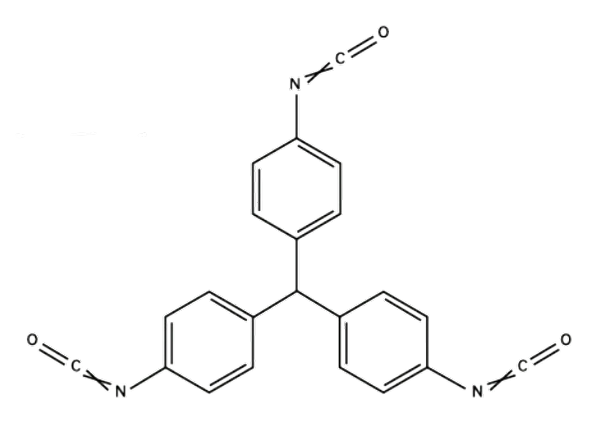
Among the specialty crosslinkers available today, Triphenylmethane-4,4',4''-Triisocyanate, commonly supplied as Isocyanate RE, has become a preferred solution for many industrial polyurethane adhesive formulations because of its high reactivity and ability to build a dense three-dimensional polymer network.
Why Rubber-to-Metal Bonding Is More Challenging Than It Appears
At first glance, bonding rubber to steel or aluminum may seem straightforward. Modern polyurethane adhesives already provide impressive initial adhesion, so many assume the adhesive alone determines performance.
In reality, most bond failures occur months or even years after production—not during the initial bonding process.
The reason lies in the operating environment.
An automotive engine mount may experience millions of vibration cycles during its lifetime. Conveyor rollers operate continuously under mechanical stress. Rubber seals expand and contract with temperature changes, while industrial machinery is frequently exposed to lubricants, fuels, cleaning chemicals, and moisture.
Each of these conditions slowly weakens the adhesive layer if the polymer network is not sufficiently crosslinked.
Rather than focusing only on initial bond strength, experienced formulation engineers pay closer attention to long-term durability, fatigue resistance, and environmental stability.
What Does a Polyurethane Crosslinker Actually Do?
A polyurethane adhesive contains polymers that provide flexibility and adhesion, but these polymer chains require chemical connections to achieve their full mechanical potential.
A crosslinker reacts with functional groups inside the adhesive formulation, creating bridges between polymer chains. As curing progresses, individual molecules become part of an interconnected network rather than existing as separate linear chains.
This structural change has a profound influence on adhesive performance.
Instead of softening under heat or gradually flowing under continuous stress, a properly crosslinked adhesive maintains its shape and mechanical properties over extended periods.
Typical improvements include:
-
Higher bond strength under dynamic loading
-
Better resistance to oil, solvents, and chemicals
-
Improved heat resistance
-
Reduced creep under continuous stress
For manufacturers producing safety-critical components, these improvements directly influence product reliability and warranty performance.
Why Crosslink Density Matters
Crosslink density refers to the number of chemical bridges formed throughout the cured adhesive.
A higher crosslink density generally results in:
-
Greater mechanical strength
-
Better dimensional stability
-
Higher abrasion resistance
-
Improved chemical resistance
However, maximizing crosslink density is not always the objective.
An excessively rigid adhesive may lose flexibility and become brittle, particularly in applications requiring continuous movement.
Successful formulations, therefore, balance flexibility with structural stability.
This balance explains why experienced adhesive manufacturers spend considerable time optimizing crosslinker selection instead of simply increasing crosslinker dosage.
The Role of Triphenylmethane-4,4',4''-Triisocyanate
Triphenylmethane-4,4',4''-Triisocyanate belongs to a family of aromatic trifunctional isocyanates used as polyurethane crosslinkers.
Unlike conventional diisocyanates containing two reactive isocyanate groups, this material contains three reactive sites capable of participating in crosslinking reactions.
That additional functionality creates a more interconnected polymer structure.
In practical applications, this often translates into:
-
Improved rubber-to-metal adhesion
-
Higher resistance to fatigue
-
Better heat stability
-
Longer service life
-
Improved resistance to solvents and industrial chemicals
Because of these characteristics, Isocyanate RE has become widely used in industrial adhesives where long-term reliability is more important than achieving the highest initial strength alone.
Factory Perspective: What Engineers Really Measure
Technical literature frequently highlights laboratory properties such as viscosity, NCO content, or curing speed.
Inside manufacturing facilities, however, quality engineers often evaluate very different indicators.
Their primary concerns include production consistency, processing stability, and long-term customer satisfaction.
Typical evaluation criteria include:
-
Batch-to-batch consistency
-
Pot life during production
-
Stability under seasonal humidity changes
-
Compatibility with existing formulations
A crosslinker that delivers excellent laboratory performance but creates inconsistent curing during large-scale production can significantly increase manufacturing costs.
For this reason, industrial material selection is often driven by process stability rather than laboratory records.
A Real Production Scenario
A manufacturer producing industrial conveyor rollers experienced occasional bond separation between rubber lagging and steel cores.
The adhesive formulation performed well during factory testing, yet several customers reported edge lifting after prolonged outdoor use.
Investigation showed that the adhesive layer gradually lost mechanical integrity under repeated moisture exposure and cyclic loading.
Instead of replacing the polyurethane resin, engineers modified only the crosslinking system.
Following formulation optimization with Triphenylmethane-4,4',4''-Triisocyanate, the production team observed more consistent curing, fewer rejected parts, and significantly improved field performance.
Perhaps the most important outcome was not higher laboratory bond strength but improved production repeatability.
For manufacturers producing thousands of bonded components every month, consistency often provides greater economic value than achieving marginally higher peak performance.
Comparing Crosslinking Strategies
Performance Factor Standard Polyurethane System Optimized Crosslinked System Initial Adhesion Good Excellent Heat Resistance Moderate High Oil Resistance Moderate High Fatigue Resistance Moderate Excellent Service Life Standard Extended Production Consistency Good Excellent Although every formulation differs, stronger crosslinking generally produces adhesives capable of maintaining performance under more demanding operating conditions.
Common Factors Behind Bond Failure
Adhesive failure rarely results from a single cause.
In most industrial investigations, engineers identify several contributing factors acting together.
The most common include:
-
Inadequate surface preparation
-
Incorrect adhesive mixing ratios
-
Moisture contamination
-
Insufficient curing time
Interestingly, adhesive chemistry itself is often not the primary problem.
Instead, failures frequently originate from inconsistent production practices.
Surface cleanliness, environmental humidity, and accurate material weighing can influence bonding performance as much as adhesive selection itself.
Best Practices for Industrial Adhesive Production
Manufacturers seeking reliable polyurethane bonding generally follow several practical principles.
First, moisture exposure should be minimized throughout storage and production because isocyanates readily react with water.
Second, adhesive formulations should always be validated under actual manufacturing conditions rather than relying exclusively on laboratory testing.
Third, production personnel should understand that curing behavior varies with temperature, humidity, substrate type, and adhesive thickness.
Finally, formulation changes should be evaluated systematically.
Changing multiple raw materials simultaneously makes troubleshooting considerably more difficult if unexpected performance issues arise.
Looking Beyond Laboratory Data
One misconception within the adhesive industry is that the strongest laboratory formulation automatically becomes the best commercial product.
Experienced manufacturers know otherwise.
Production environments introduce variables that laboratory testing cannot fully reproduce.
Equipment tolerances, operator practices, seasonal humidity changes, substrate variations, and production speed all influence adhesive performance.
Consequently, successful industrial formulations are those capable of maintaining reliable performance under real manufacturing conditions rather than only under ideal laboratory settings.
This practical perspective explains why many adhesive producers continue to invest heavily in formulation optimization instead of pursuing maximum theoretical strength.
Why Crosslinker Selection Influences Manufacturing Costs
Crosslinkers are often viewed simply as performance additives, yet their influence extends far beyond mechanical properties.
A well-matched polyurethane crosslinker can reduce production waste, minimize warranty claims, improve manufacturing efficiency, and extend the service life of finished products.
From a business perspective, these advantages frequently outweigh small differences in raw material cost.
Factories rarely calculate value solely by purchase price.
Instead, they consider the overall cost of production, including process stability, product consistency, customer satisfaction, and long-term reliability.
This broader evaluation explains why specialty crosslinkers such as Triphenylmethane-4,4',4''-Triisocyanate continue to play an important role in industrial polyurethane adhesive systems.
Frequently Asked Questions
Why is crosslinking important in polyurethane adhesives?
Crosslinking creates a three-dimensional polymer network that improves mechanical strength, durability, heat resistance, and resistance to chemicals and fatigue.
Why are rubber-to-metal applications particularly demanding?
Rubber and metal expand, deform, and respond to stress differently. The adhesive layer must continuously absorb these differences without losing adhesion.
What advantages does Triphenylmethane-4,4',4''-Triisocyanate provide?
Its trifunctional molecular structure allows higher crosslink density, improving long-term adhesion, environmental resistance, and mechanical stability in polyurethane adhesive systems.
Does stronger initial adhesion always mean better long-term performance?
No. Long-term durability depends on formulation balance, curing quality, environmental resistance, and production consistency rather than initial strength alone.
What should manufacturers consider when selecting a polyurethane crosslinker?
Besides technical specifications, engineers should evaluate compatibility with existing formulations, processing stability, moisture sensitivity, production efficiency, and long-term field performance.
Industrial bonding is becoming increasingly demanding as equipment operates under higher loads, longer service intervals, and more aggressive environments. Adhesive performance is therefore determined not only by resin chemistry but also by how effectively the polymer network is built during curing.
Selecting the appropriate polyurethane crosslinker is one of the most effective ways to improve adhesive reliability without redesigning an entire formulation. Whether the application involves automotive components, conveyor systems, industrial rollers, footwear, or heavy machinery, optimized crosslinking contributes to stronger bonds, improved resistance to environmental aging, and more consistent manufacturing results.
For manufacturers focused on producing reliable polyurethane adhesive systems, investing in the right crosslinking technology is not simply a material choice—it is a long-term strategy for improving product quality, production efficiency, and customer confidence.
https://www.further-chem.com/
further -
-
AuthorPosts

- You must be logged in to reply to this topic.