
- This topic is empty.
-
AuthorPosts
-
2026-10-15 at 6:19 pm #12943
■ 1. Background
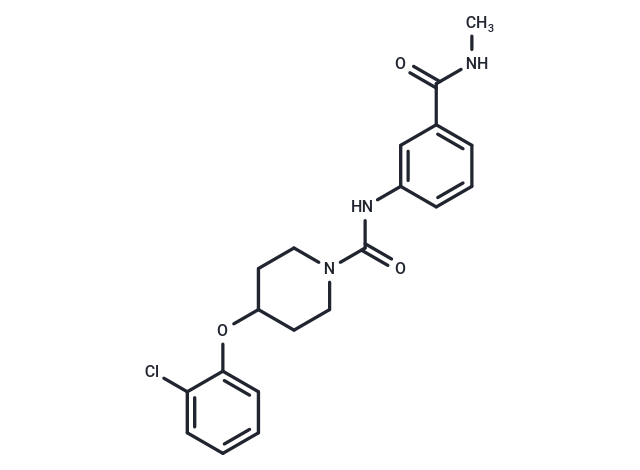
▲ A939572 (T4515),CAS: 1032229-33-6
A939572 (T4515), CAS: 1032229-33-6 is a high-affinity, small-molecule inhibitor of stearoyl‑CoA desaturase 1 (SCD1), the endoplasmic reticulum Δ9‑desaturase that converts saturated fatty acyl‑CoAs into monounsaturated fatty acyl‑CoAs. Quantitatively, A939572 inhibits mouse SCD1 with sub‑4 nM potency and human SCD1 with an IC50 of 37 nM, enabling precise, nanomolar‑range control of SCD1 activity across common experimental systems. Mechanistically, SCD1 introduces a cis double bond at the Δ9 position of palmitoyl‑CoA (16:0) and stearoyl‑CoA (18:0) to generate palmitoleoyl‑CoA (16:1n‑7) and oleoyl‑CoA (18:1n‑9), respectively. This oxidation requires molecular oxygen and an ER electron‑transfer chain comprising NADH‑cytochrome b5 reductase and cytochrome b5, which deliver reducing equivalents to the SCD1 diiron center that catalyzes desaturation [1,2]. By binding to and inhibiting SCD1, A939572 disrupts this electron‑coupled desaturation step, thereby lowering cellular production of monounsaturated fatty acids (MUFAs) and secondarily increasing pools of saturated acyl‑CoAs.
Within the broader lipid metabolic pathway, SCD1’s MUFA products are incorporated into triacylglycerols, phospholipids, and cholesteryl esters, shaping membrane fluidity, lipid droplet dynamics, and the availability of acyl chains for complex lipid biosynthesis [1]. Inhibition by A939572 therefore modulates multiple downstream lipid classes and shifts the cellular “desaturation index” (e.g., 16:1/16:0 and 18:1/18:0 ratios), a widely used pharmacodynamic readout of SCD1 activity. Because SCD1 sits at a key branch point connecting de novo lipogenesis with membrane remodeling and neutral lipid storage, acute or chronic application of A939572 can be used to probe how MUFA availability influences metabolic flux, organelle homeostasis, and lipid‑dependent signaling environments.
Experimentally, A939572 provides a rigorously defined tool for dissecting SCD1 function in human and mouse cells and in vivo models. The differential potency (<4 nM for mouse vs 37 nM for human) supports cross‑species study designs that titrate SCD1 activity to matched desaturation indices, enabling careful alignment of biochemical effects across models. In cell culture, investigators can use A939572 to manipulate the 16:1/16:0 and 18:1/18:0 balances and to test the MUFA requirement for lipid droplet formation, membrane biophysical properties, and the acyl‑chain composition of glycerophospholipids and cholesteryl esters. In systems biology contexts, perturbing SCD1 with A939572 helps map coupling between reductive power (NADH), ER electron‑transfer components, oxygen availability, and fatty acid desaturation, and to quantify how these constraints reprogram flux through dehydrogenase/desaturase nodes [2]. Collectively, A939572 is well suited for mechanistic studies of lipid homeostasis, evaluation of SCD1 dependency in metabolic reprogramming, and establishing causal links between Δ9‑desaturation, MUFA pools, and emergent cellular phenotypes, with desaturation indices serving as robust, pathway‑proximal biomarkers [1].
■ 2. Literature review
■ 2.1 Gut Microbiota-Derived Tyrosol Alleviates Radiation-Induced Intestinal Injury via Targeting SCD1-MUFA Axis to Suppress ER Stress
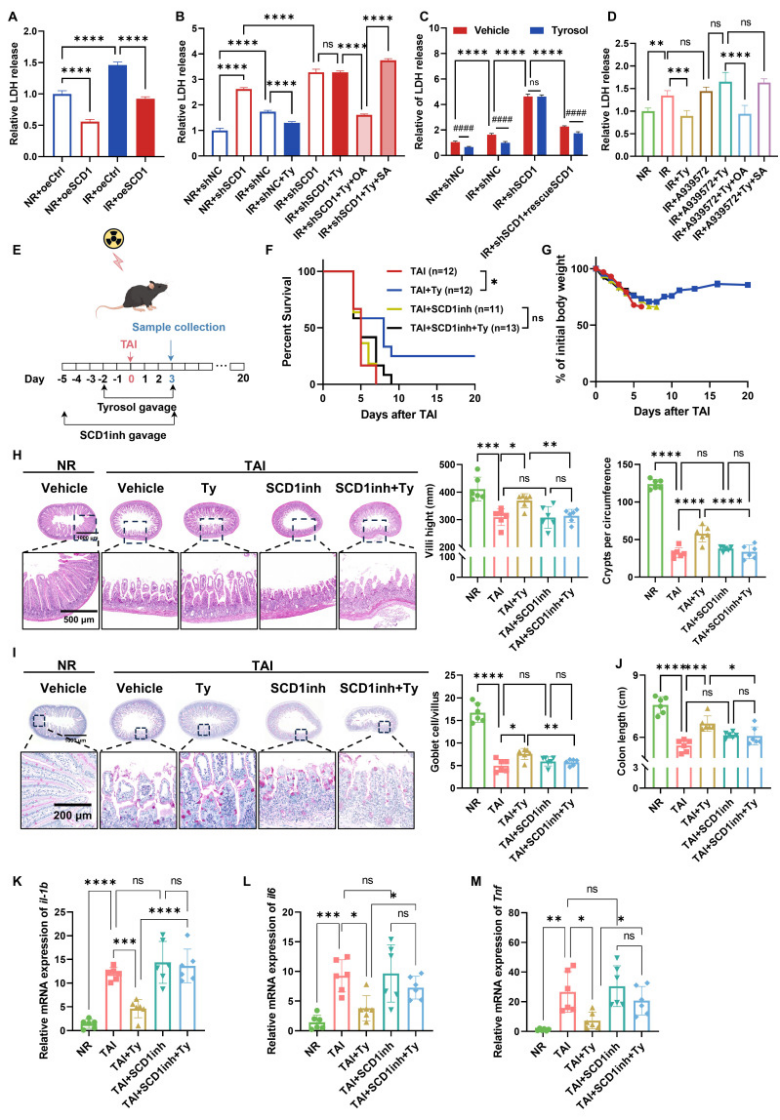
▲ Tyrosol mitigates RIII in a SCD1-dependent manner. (A) LDH release assay of SCD1-overexpressing HIECs at 72 h after 8 Gy IR. (B) LDH release assay of SCD1-depleted HIECs pretreated with tyrosol combined with OA or SA, assessed at 72 h post-IR. (C) LDH release assay of SCD1-depleted HIECs pretreated with tyrosol alongside SCD1 rescue or without, evaluated at 72 h after 8 Gy IR. (D) LDH release assays of HIECs pretreated with tyrosol combined with A939572, OA, or SA, assessed at 72 h post-8 Gy IR. (E) Schematic of in vivo treatment: tyrosol (50 mg/kg) gavage combined with SCD1 inhibitor (A939572, 30 mg/kg) intraperitoneal injection, with irradiated mice monitored over 20 days or euthanized on day 3 post-TAI. (F–G) Survival curves (F) and body weight changes (G) of irradiated mice over the observation period. (H–I) Representative H&E (H) and PAS (I) stained intestinal sections at day 0 and 3 post-12 Gy TAI; right, quantification of villus height, crypt numbers (H), and goblet cell count per villus (I). (J) Colon length of mice sacrificed on day 3 after 12 Gy TAI. (K–M) qRT-PCR analysis of il1b (K), il6 (L), and Tnf (M) expression in small intestine tissues at day 3 post-12 Gy TAI. Each symbol represents one mouse. Bars represent mean ± SD. IR, irradiation; Ty, tyrosol; SCD1inh, SCD1 inhibitor (A939572); OA, oleic acid; POA, palmitoleic acid; SA, stearic acid; PA, palmitic acid. *p < 0.05, ***p < 0.001, ****p < 0.0001, ####p < 0.0001, ns, no significant difference.
A939572 (T4515) is described in this study as a selective SCD1 inhibitor. The authors examined how cellular metabolism responded to tyrosol and tested whether pharmacologic SCD1 inhibition would alter those responses. In this context, cells were pretreated with A939572 prior to assessing downstream readouts of tyrosol’s metabolic activity. The study reports that pretreatment with A939572 completely abrogated the metabolic effects of tyrosol, highlighting the compound’s functional capacity to negate tyrosol-induced metabolic changes under the experimental conditions used. By applying A939572 as a targeted SCD1 inhibitor, the investigators were able to directly test the SCD1 dependence of the observed metabolic shifts, and the complete abrogation they observed emphasized the effectiveness of A939572 in suppressing these tyrosol-driven responses. The description of A939572 as selective for SCD1, together with its ability to fully eliminate the measured metabolic effects when applied before tyrosol exposure, positions A939572 as a precise pharmacological tool within this experimental framework. Overall, the study’s findings on A939572 center on its selectivity for SCD1 and its clear capacity to fully suppress the metabolic changes elicited by tyrosol when administered as a pretreatment in the cellular assays reported.[3]
■ 2.2 Adipocyte-specific Zeb1 downregulation remodels the tumor-associated adipose microenvironment to facilitate female breast cancer progression
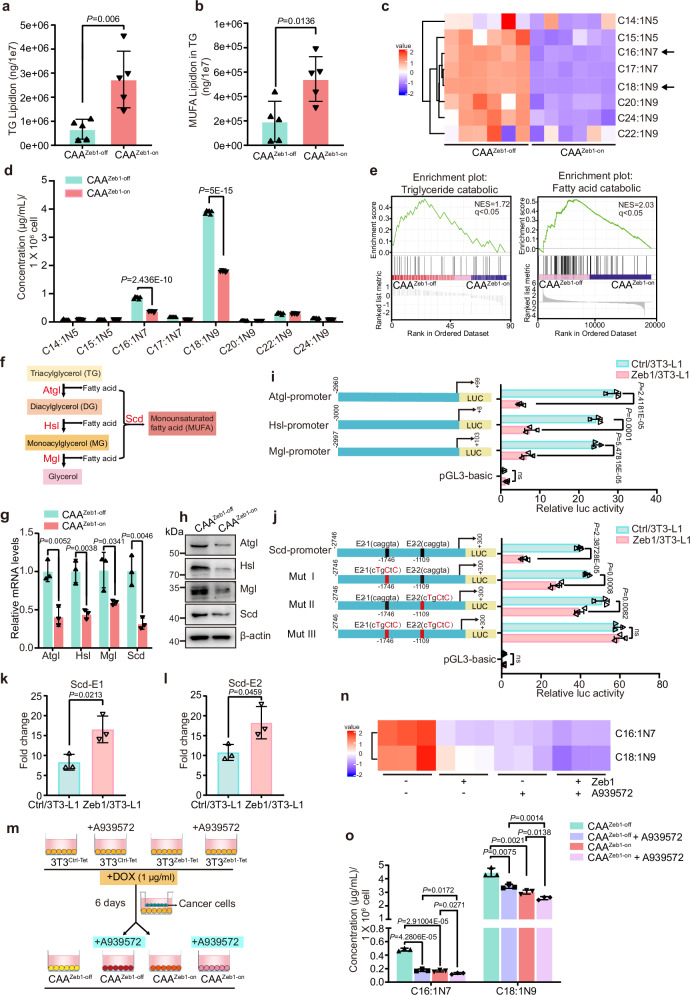
▲ (a) Triglyceride content by non-targeted lipidomics analysis in CAA^Zeb1-off and CAA^Zeb1-on cells (n = 5 independent experiments). (b) Content of monounsaturated fatty acid (MUFA) in triglycerides (n = 5 independent experiments). (c, d) Targeted metabolomics analysis of medium- and long-chain fatty acids (c) and their differential contents (d) in the supernatant from CAA^Zeb1-off and CAA^Zeb1-on cells (n = 6 independent experiments). (e, f) RNA-sequencing combined with GSEA for gene sets related to triglyceride and fatty acid metabolism in CAA^Zeb1-off and CAA^Zeb1-on cells (NES, normalized enrichment score; n = 3 independent experiments). (g, h) Relative mRNA (g) and protein (h) levels of Atgl, Hsl, Mgl, and Scd in CAA^Zeb1-off and CAA^Zeb1-on cells (n = 3 independent experiments). (i) Luciferase assay for the wild-type promoters of Atgl (−2960/+99), Hsl (−3000/+8), and Mgl (−2997/+103) in Ctrl/3T3-L1 and Zeb1/3T3-L1 cells (n = 3 independent experiments). (j) Luciferase assay for the wild-type (−2746/+300) and E2-box-mutated promoters of Scd in Ctrl/3T3-L1 and Zeb1/3T3-L1 cells (n = 3 independent experiments). (k, l) ChIP assay for the recruitment of Zeb1 to the endogenous Scd promoter in Ctrl/3T3-L1 and Zeb1/3T3-L1 cells (n = 3 independent experiments). (m) Scheme of CAA^Zeb1-off and CAA^Zeb1-on co-culture with EO771 cells in the presence or absence of A939572 (100 nM) for 6 days. (n, o) Targeted metabolomics analysis of medium- and long-chain fatty acids (n) and their differential contents (o) in the supernatant from CAA^Zeb1-off and CAA^Zeb1-on cells in the presence or absence of A939572 (n = 3 independent experiments). Data were expressed as means ± SEM. Indicated P-values were calculated using two-tailed unpaired Student’s t-test.
A939572 (T4515) is identified in this study as a Scd inhibitor, as stated when the authors proposed combining it with an AMR antagonist. The experimental design included a co-culture system using CAAZeb1-off and CAAZeb1-on adipocytes with EO771 breast cancer cells, where A939572 was applied at 100 nM or omitted for a 6-day period to assess its role under defined Zeb1 states. Following this co-culture, the investigators performed targeted metabolomics focused on medium- and long-chain fatty acids in the supernatant, explicitly comparing conditions with and without A939572 across three independent experiments to determine differential fatty acid contents. The study context frames A939572’s role within Zeb1/Scd-related lipid remodeling, and the authors hypothesized that combining the Scd inhibitor A939572 with an AMR antagonist could disrupt the relevant interactions. Collectively, the evidence specifies A939572’s function as a Scd inhibitor, its concentration and duration of use in a defined adipocyte–cancer cell co-culture model, and its inclusion in a targeted fatty acid metabolomic workflow designed to quantify changes attributable to its presence.[4]
■ 3. Conclusion
A939572 functions as a potent and selective small-molecule inhibitor of stearoyl‑CoA desaturase 1 (SCD1), blocking the enzyme’s Δ9 desaturation of saturated fatty acyl‑CoAs to monounsaturated fatty acyl‑CoAs by disrupting its diiron-catalyzed electron transfer mechanism. Literature findings consistently demonstrate that A939572 effectively suppresses SCD1 activity in both human and mouse models, leading to reduced monounsaturated fatty acid production and altered lipid profiles, as evidenced by decreased desaturation indices. Its application has clarified the dependence of metabolic responses on SCD1 activity, such as the complete abrogation of tyrosol-induced metabolic changes and modulation of lipid remodeling in adipocyte-tumor co-culture systems. Future research may leverage A939572 to systematically dissect SCD1’s role in metabolic reprogramming, lipid homeostasis, and related pathologies including cancer and radiation-induced tissue injury, as well as to explore combinatorial therapeutic strategies targeting lipid metabolism.
■ 4. Q&A
Q1: What is the primary molecular target and mechanism of action of A939572?
A1: A939572 selectively inhibits stearoyl‑CoA desaturase 1 (SCD1) by blocking its Δ9 desaturation activity, which involves the diiron catalytic center and electron transfer from NADH‑cytochrome b5 reductase and cytochrome b5, thus reducing monounsaturated fatty acid production.
Q2: How has A939572 been used to demonstrate the role of SCD1 in cellular metabolism?
A2: A939572 has been used to fully abrogate tyrosol-induced metabolic effects by pretreatment in cell assays and to modulate lipid remodeling in adipocyte-breast cancer co-culture models, showing its utility as a precise tool to dissect SCD1-dependent metabolic pathways.
Q3: What are the species-specific potencies of A939572 against SCD1?
A3: A939572 inhibits mouse SCD1 with an IC50 of less than 4 nM and human SCD1 with an IC50 of 37 nM, allowing titration of SCD1 activity across species in experimental models.
■ 5. Reference
[1] Paton CM, Ntambi JM, et al. Biochemical and physiological function of stearoyl-CoA desaturase. Am J Physiol Endocrinol Metab. 2009;297(1):E28-E37.
[2] Enoch HG, Catala A, et al. Mechanism of desaturation by the microsomal stearoyl-CoA desaturase system. J Biol Chem. 1976;251(16):5095-5103.
[3] Jin X, Xue H, Shi X, Zhou Y, Zhang J, Zeng L, et al.. Gut Microbiota-Derived Tyrosol Alleviates Radiation-Induced Intestinal Injury via Targeting SCD1-MUFA Axis to Suppress ER Stress. International Journal of Biological Sciences. 2026;22(5):2469-2491.
[4] Cao L, Sun W, Chen X, Liu L, Zhao S, Liu J, et al.. Adipocyte-specific Zeb1 downregulation remodels the tumor-associated adipose microenvironment to facilitate female breast cancer progression. Nature Communications. 2025;16(1):.
https://www/targetmol.com/
TargetMol Chemicals Inc. -
AuthorPosts

- You must be logged in to reply to this topic.