
- This topic is empty.
-
AuthorPosts
-
2026-10-23 at 4:29 pm #13049
Addressing the Core Challenge in Surgical Gas Infrastructure
Hospitals planning or upgrading operating rooms, ICUs, and surgical suites face a recurring technical demand: a centralized medical vacuum infrastructure that performs reliably under continuous clinical use while integrating seamlessly with the hospital’s broader medical gas network. For institutions searching for medical vacuum systems for clinical surgery specifications, the real requirement usually extends beyond a single vacuum pump — it includes centralized infrastructure design, redundancy engineering, contamination control, and a single accountable partner capable of delivering the entire gas engineering scope. Chengdu Lianbang Medical Technology Co., Ltd., operating under the brand Lianbang Medical (LBYL Medical), positions itself in this exact space as a medical gas overall solution provider integrating R&D, design, manufacturing, installation, and after-sales service.
Medical Vacuum Pipeline System (MVPS): Engineering for Surgical Suction and Drainage
At the center of Lianbang Medical’s surgical gas offering is the Medical Vacuum Pipeline System (MVPS), built specifically for surgical suction and drainage applications where reliable negative pressure is non-negotiable. The system flow runs from the Vacuum Pump through a Bacterial Filter (0.22μm), into a Vacuum Tank, then a Sewage Tank, before reaching the Piping System and finally the Terminal. This sequential architecture is designed to ensure contamination control alongside negative-pressure stability.
The MVPS incorporates an N+1 redundant design, with flow capacity reaching ≥110% of the design value in the event of a single component failure — directly addressing the operating-room requirement for backup capacity without interruption. Real-time monitoring tracks vacuum levels within a range of -50 to -90 kPa, in line with ISO 7396-1, while filter pressure differential is also continuously monitored. An audio-visual alarm system flags negative pressure deviation, filter blockage, or pump failure, giving clinical engineering teams immediate visibility into system health.
For pump selection, Lianbang Medical offers two configurations suited to different operational needs. The oil-free claw pump delivers an absolute vacuum of ≥90 kPa, a single pump flow of 250 m³/h, and power consumption of 5.5kW with a reported 15% energy saving; noise is held to ≤78 dB(A), with a design life of 5-10 years and a maintenance cycle of 6-24 months. For facilities preferring an alternative configuration, the oil-lubricated vane pump provides an absolute vacuum of ≤86 kPa, a single pump flow of 180 m³/h, power of 6.0kW, noise at ≤60 dB(A), and a maintenance cycle of 6-12 months.
Integrating Vacuum Infrastructure into a Centralized Gas Network
A vacuum system installed in isolation does not fully solve the centralized infrastructure problem hospitals are actually trying to address. Lianbang Medical’s broader Medical Gas Pipeline System (MGPS) places the MVPS as one of six subsystems within a unified architecture, alongside medical oxygen, medical air, dental vacuum, special gases for operating rooms, and the pipes-and-terminals network. This six-subsystem structure reflects the company’s core value proposition: one partner, one guarantee, one service team, built on the combination of in-house gas source equipment manufacturing with complete pipeline construction qualifications.
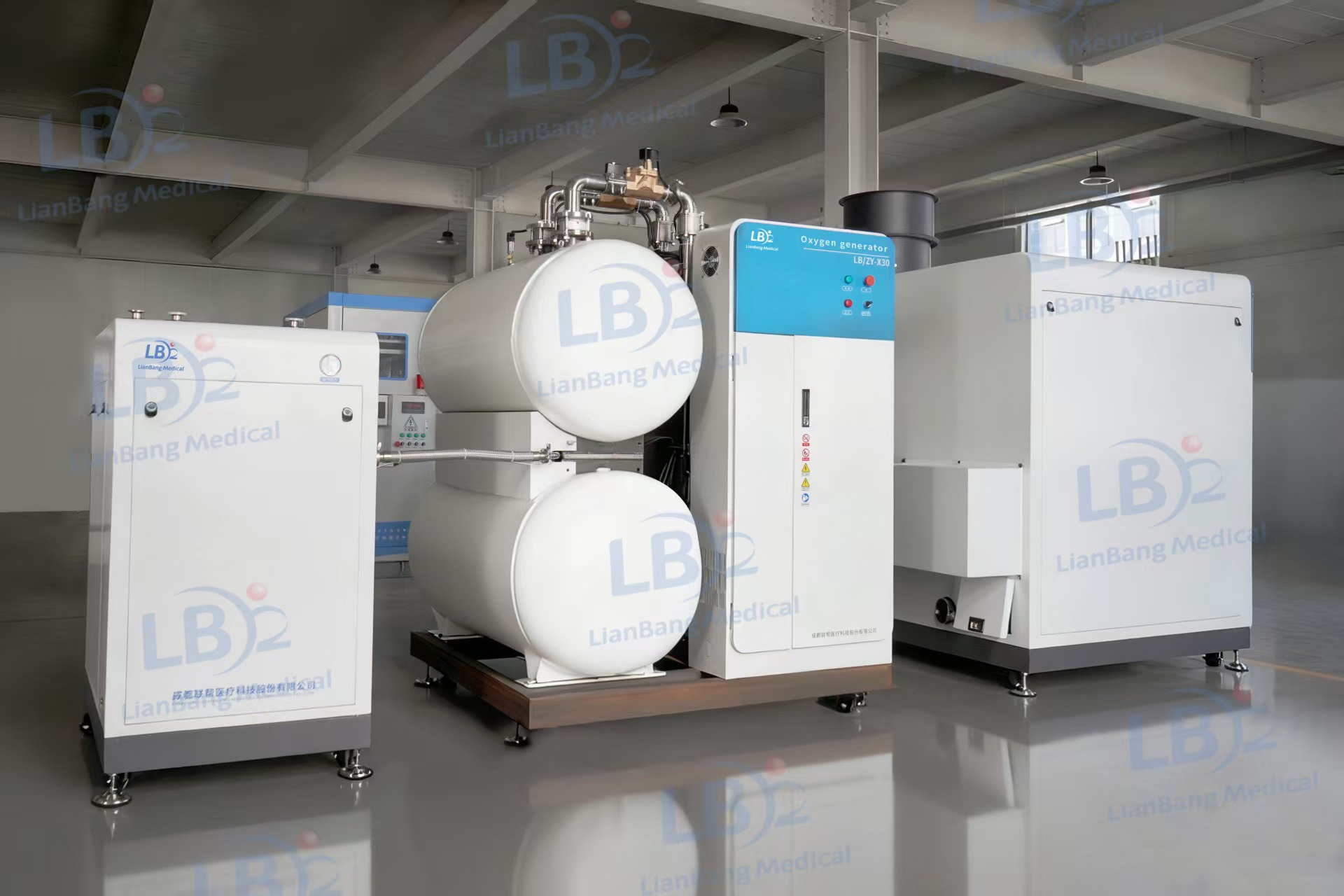
Within this integrated framework, the N+1 redundant design is applied consistently across the network in accordance with NFPA 99, and the modular structure is reported to reduce maintenance cost by 80%. A full-system remote monitoring platform supports automatic diagnosis and warning, with a reported 90% reduction in manual intervention — relevant for hospitals seeking centralized oversight rather than siloed equipment management. Energy consumption across the combined system is targeted at an overall saving of ≥30%.
Case Validation: Large-Scale Hospital Deployment
The practical application of this centralized approach is documented in the Taikang Tongji (Wuhan) Hospital project, located in Hanyang District, Wuhan, Hubei Province. The hospital, built to China’s Grade III Class A hospital standard, covers a site area of about 90,000 square meters with planned beds exceeding 1,000. The medical gas system deployed there covered central oxygen supply, central suction, compressed air, dental suction, dental compressed air, carbon dioxide, ward terminal facilities, and area alarm systems.
The configuration included one liquid oxygen station, two busbar oxygen stations, three air stations, two negative pressure suction stations, and two carbon dioxide busbar stations, with all air compressors specified as oil-free. Remote monitoring was installed at each gas source station and on every floor. Contamination control measures included bacteria removal before vacuum pumps and sterilization at exhaust outlets. Piping materials were selected deliberately: medical seamless copper tubes for positive-pressure gas and oxygen equipment belt piping, and seamless stainless steel for negative-pressure piping — a materials decision consistent with the company’s documented approach of favoring stainless steel for negative-pressure and higher-durability applications. BIM technology was used throughout the design process, and pipeline specifications were calculated at 100% load standard.
Compliance, Service Model, and Operational Track Record
Specification compliance matters as much as hardware for surgical-grade vacuum infrastructure. Lianbang Medical’s gas engineering references ISO 7396-1 for vacuum monitoring thresholds and NFPA 99 for redundancy and alarm standards, alongside the company’s broader certification base that includes ISO 9001, ISO 13485, ISO 14001, and ISO 45001, in addition to CE marking. The company also holds a Special Equipment Permit for Pressure Pipeline Design and Installation, directly relevant to the pipeline engineering work required for centralized vacuum and gas infrastructure, along with Building Mechanical and Electrical Installation Engineering Qualification and Electronic and Intelligent Engineering Qualification.
Beyond installation, Lianbang Medical structures its surgical gas engineering around a one-stop service model spanning R&D design, manufacturing, installation, and after-sales support. This includes personnel training, system inspection, maintenance and repair, equipment management, operation management, operation and maintenance hosting, spare parts supply, and upgrading and reconstruction — formalized through nearly 1,000 technical service and operation/maintenance hosting agreements. The company holds a Five-Star After-Sales Service Certification (GB/T 27922-2011), and reports zero fault complaints over 29 years of medical gas engineering since its founding on March 19, 1997.
Why Centralized, Single-Source Engineering Matters for Surgical Facilities
For hospitals evaluating medical vacuum systems for clinical surgery, the specification conversation inevitably expands into redundancy design, monitoring integration, materials selection, and long-term maintenance planning. Lianbang Medical’s approach — combining the MVPS technical architecture with the six-subsystem MGPS framework, backed by NFPA 99– and ISO 7396-1-aligned engineering, documented large-scale hospital case performance, and a structured after-sales hosting program — reflects an effort to answer that full specification set through a single accountable engineering partner rather than a collection of disconnected vacuum components. With over 3,000 hospital projects delivered and a service network covering more than 30 domestic regions, Chengdu Lianbang Medical Technology Co., Ltd. presents its vacuum and gas pipeline work as part of a broader, centralized medical gas engineering practice built over 29 years of continuous operation.
https://www.lbylmedical.com
Chengdu Lianbang Medical Technology Co., Ltd. -
AuthorPosts

- You must be logged in to reply to this topic.