
- This topic is empty.
-
AuthorPosts
-
2026-10-27 at 2:23 pm #13110
Thin-wall packaging producers — those molding yogurt cups, drink cups, food containers, and other ultra-thin disposable products — operate under a specific set of pressures: melt must fill a thin cavity before it solidifies, shot weight must stay consistent across multi-cavity tools, and every second of cycle time adds up across millions of units. Within this niche, DKM Machinery and SINO MOULD have built a documented track record around low-inertia, high-speed injection molding machines purpose-engineered for thin-wall applications, backed by over a decade of applied research and field-verified cycle data.
What "Thin-Wall" Actually Requires
According to DKM’s own technical documentation, thin-wall molding is defined as wall thickness between 0.2–0.6mm for molding areas under 0.1㎡, with larger surface areas qualifying at up to 1.5mm. At this thickness, filling time for a 0.4mm wall is only 0.2–0.3 seconds — a window narrow enough that conventional machines running at roughly 100mm/s struggle to complete the shot before the melt begins to solidify, leading to short shots, flash, and shrinkage marks. DKM states that machines serving this category need 200–800mm/s injection speed, high-precision injection control, rapid mold opening and closing, and 3-axis linkage. This technical framework, developed over 15 years of thin-wall research according to the company, underlies the design of its DFS Series Fast Speed Injection Molding Machine and HH Series High Speed Plastic Injection Molding Machine.
The Low-Inertia Mechanism Behind the Speed
The core differentiator in DKM’s thin-wall lineup is its patented low-inertia servo system combined with low-inertia injection technology. The company describes an advanced structure that reduces the moving unit’s weight to approximately half that of standard machines, which directly lowers the energy needed to accelerate and decelerate the injection unit. This is paired with a single-cylinder injection system that DKM states provides stable and consistent injection pressure throughout the shot. On the DFS Series specifically, this translates into a documented injection speed of 444mm/s reached in 0.13 seconds, with a maximum injection speed of 500mm/s. Shot weight repeatability is held to ≤2‰, a tolerance DKM attributes directly to the low-inertia design minimizing cycle-to-cycle variation.
Notably, this low-inertia technology did not emerge in isolation. DKM has maintained a formal collaboration with South China University of Technology through the National Engineering Research Center of Novel Equipment for Polymer Processing — DKM Branch Centre, inaugurated in May 2021 and led by an academician of the Chinese Academy of Engineering. Per the company’s account, low-inertia high-precision technology has been developed in-house since 2018 and was independently measured at 20% energy savings by the National Plastics Machinery Quality Inspection and Testing Centre — a third-party verification point worth noting for buyers evaluating energy-efficiency claims.
DFS Series: Engineering Detail for Thin-Wall Output
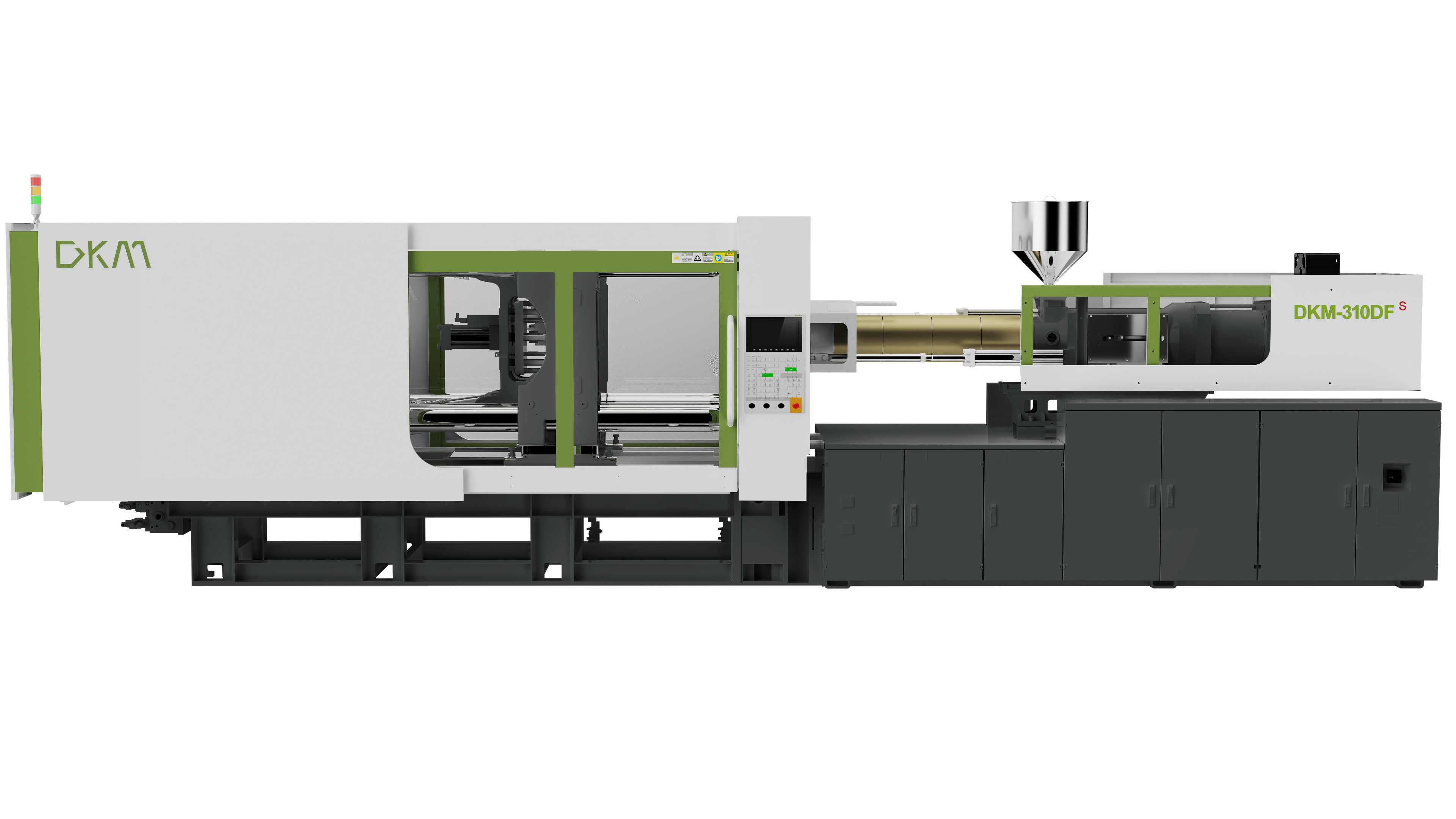
The DFS Series spans clamping forces of 250T, 310T, 360T, and 460T and is built as a hybrid toggle machine specifically for thin-wall applications. Beyond raw injection speed, DKM points to an "electric charging" function — simultaneous mold opening, ejecting, and pre-charging — that the company credits with shortening overall molding cycle time by 30–50% versus conventional thin-wall lines. The design also removes the nitrogen accumulator found in older architectures, a change DKM says reduces maintenance requirements while a larger oil pump motor delivers a 40% power boost; the net result, per DKM, is 25–30% energy savings. Reinforced semi-central clamping and thickened platens are included to preserve mold accuracy over long production runs, and the company references a "coin test" — a coin standing upright on the tie bar during mold opening and closing — as a stability demonstration.
DKM further states that more than 200 DFS units are currently running across China with validated field performance, giving the series a meaningful installed base to draw operational feedback from rather than resting on laboratory figures alone.
HH Series and the Broader Tonnage Range
For producers needing a wider tonnage window, the HH Series High Speed Plastic Injection Molding Machine covers 200 to 1300 tons with injection speeds of 300–500mm/s, which DKM positions as meeting the filling-speed threshold thin-wall products demand. A notable detail in the HH Series design is its internal heating architecture, which concentrates heat between the barrel and screw and keeps external surface temperature below 50°C — reducing thermal energy waste during continuous operation, according to DKM.
Integration Into Full Thin-Wall and IML Lines
Speed at the machine level only solves part of the equation; DKM and SINO MOULD pair their thin-wall machines with matched molds and automation into complete Thin-Wall IML Production Lines. These lines combine the DFS machine, a SINO MOULD thin-wall IML mold, an in-mold labeling robot, and precision temperature control (core/cavity temperature difference held within ±1°C). The companies report a resulting molding cycle of 2.8–3.5 seconds, more than a 50% improvement over traditional lines, ultrathin walls from 0.28mm, label positioning accuracy of ≤0.01mm, and a yield rate of ≥99%. Moog servo valves paired with a KEBA controller are cited as delivering 1‰ repeatability on these integrated lines.
Documented Application Cases
Field data referenced by the companies includes a 500–1000ml PP/PS tea/drink cup molded on a DKM-360DFS with an 8-cavity thin-wall IML mold, achieving a 6-second cycle time; a yogurt cup application on a DKM-310DFS with a 4-cavity IML mold, running a 5.3-to-5.8-second cycle; and an 8-cavity thin-wall IML intelligent cup production line, demonstrated live at CHINAPLAS 2025, combining the DKM-360DFS with a high-speed IVI-IML robot to mold an 8-cavity, 0.35mm-thick cup with a 120mm cavity height in 5.5 seconds. Customer feedback on the tea/drink cup and yogurt cup applications was described by the companies as consistently positive, gathered through direct customer channels.
Summary for Buyers Evaluating Thin-Wall Equipment
For packaging producers weighing equipment options against long cycle times and inconsistent shot quality, the documented combination of low-inertia servo and injection technology, 200–800mm/s speed ranges, third-party-verified energy savings, and an installed base exceeding 200 DFS units provides a concrete, traceable basis for evaluation — one grounded in measured cycle times, repeatability tolerances, and application-specific case data rather than generalized claims.
dkm.com
DKM Machinery -
AuthorPosts

- You must be logged in to reply to this topic.