
- This topic is empty.
-
AuthorPosts
-
2026-10-28 at 2:01 pm #13126
A river level gauge on a bridge pier. A rain gauge on a hilltop. A water quality probe in a reservoir intake. An air monitoring station beside an industrial park. A pumping station at the edge of town. Water and environmental monitoring networks are made of hundreds of small, remote stations, most of them unattended, many of them powered by solar panels and batteries, and some of them in places where the mobile signal barely reaches.
4G is the workhorse for these networks. The data volumes are small, LTE coverage is wide, and 4G equipment draws less power than 5G. What matters is choosing a 4G industrial router supplier that understands the conditions at these stations. This article describes what remote monitoring stations demand from their communication equipment and how to evaluate a supplier for this kind of work.
What Remote Stations Demand
Low and predictable power consumption
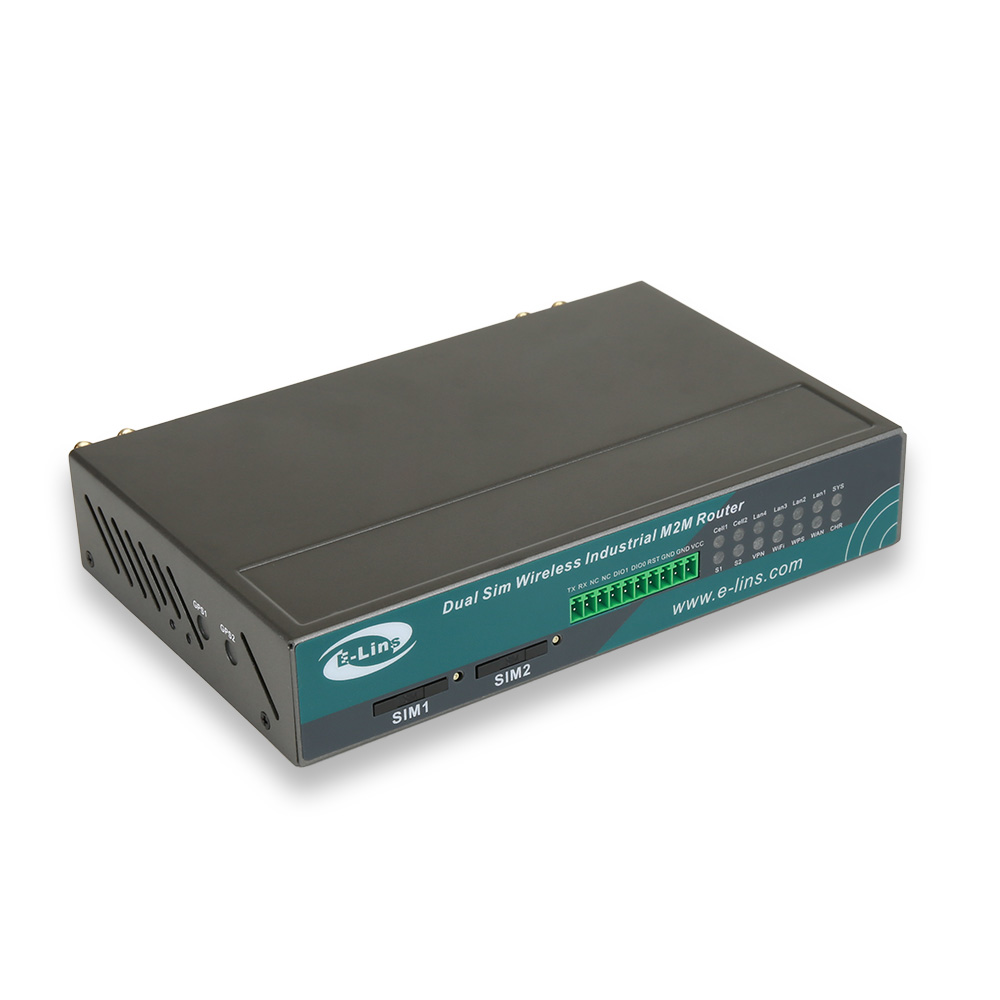
Many monitoring stations run on solar panels and batteries. Every watt the router draws has to be supplied through cloudy days and long nights, so a router’s average consumption directly affects battery and panel size. The E-Lins H685t mini embedded 4G router averages around 2 W at 12V and accepts 5 to 40V DC as standard, which suits typical 12V and 24V battery systems.
Reception where the network is weak
Rivers run through valleys, reservoirs sit behind hills, and rain gauges are placed in open, exposed locations. Signal is often marginal. High-gain antennas and good antenna placement make more difference than any other single factor. The E-Lins H820QOt outdoor 4G CPE has built-in 14dBi high-gain antennas, with reserved connectors for external antennas if a site needs more.
Weatherproofing without extra boxes
Every additional enclosure, cable gland, and antenna feed-through is another place for water to enter. The H820QOt has an IP68-rated enclosure designed for direct pole mounting without a separate protective box, and its IEEE 802.3af/at PoE-powered device interface means one Ethernet cable can carry both power and data from the cabinet at ground level.
Serial sensors and data loggers
Water level sensors, flow meters, water quality analysers and data loggers frequently communicate over RS485 or RS232, often using Modbus. The router or modem must carry that data to the central platform without changing the instruments. E-Lins M300/M400 Industrial 4G Modems convert RS232/RS485 to 4G with serial transparent transmission; the M300t adds a wide-voltage DC input, and the H685t can be ordered with RS232 or RS485 and I/O points alongside Ethernet.
Recovery after power dips
When a battery runs low overnight, or a solar controller cuts power, the router must restart cleanly and reconnect without help. Hardware watchdog timers and link self-healing mechanisms, which E-Lins builds into its routers, allow the device to recover from abnormal states automatically. Many E-Lins models also offer dual power inputs with automatic failover.
Temperature extremes
Stations in summer sun and winter frost see large temperature swings inside their cabinets. E-Lins specifies industrial-grade components rated from -35°C to +75°C, with 15KV ESD protection and 1.5KV electromagnetic isolation.
Beyond Measurement: Security and Treatment Applications
Water networks involve more than measurement stations.
Protecting water towers and utility sites
Unauthorised access to a water tower or reservoir roof can put a water supply at risk. E-Lins security designs describe a wireless module at the access point that connects to door contacts, sirens, electric locks and lights. Authorised staff arm or disarm the system by calling from registered mobile numbers, and when an intrusion is detected, the module sends SMS and data alerts to responsible staff and the control centre in real time, without an alarm panel or keypad. Running such a system on 4G removes the fixed line that an intruder could cut.
Remote treatment monitoring
The E-Lins water solution also covers recreational water facilities such as swimming pools and spas at schools, hotels, hospitals and municipal sites. Sensors monitor pH and sanitiser levels, treatment chemicals are dosed automatically, and a web-based system lets operations staff and service contractors monitor and control equipment remotely and keep service records. The same pattern applies to small treatment plants and dosing stations in water networks.
How to Choose a 4G Industrial Router Supplier for This Work
Range that matches station types
A monitoring network typically needs at least three product types: a low-power compact router for small cabinets, an outdoor unit for poles, and a serial modem for single instruments. E-Lins covers these with the H685t, the H820QOt and the M300/M400 family, and offers the H900t, with dual SIM, four DI/DO and dual power inputs, for larger stations such as pumping stations.
Security that fits utility networks
Monitoring stations should never be reachable from the public internet. E-Lins 4G routers support IPsec, OpenVPN, WireGuard, L2TP, GRE and DMVPN, depending on the model, together with APN and VPDN private networks.
Management for hundreds of stations
All E-Lins industrial routers work with the E-Lins NMS cloud platform, which provides device status monitoring, parameter management, remote firmware upgrades, and statistics. TR-069 and SNMP support allows integration with a utility’s existing tools.
Support that reduces field trips
Every avoided trip to a remote station saves a day of a technician’s time. E-Lins provides 7×24 remote technical support with an average response time of 10 minutes during business hours, packet capture analysis and remote debugging, and reports a 90% remote resolution rate. It also reports that remote management reduces on-site maintenance costs by 40%.
Experience with utility customers
Power, water and environmental organisations account for about 20% of E-Lins customers, and water conservancy and environmental protection, including hydrological and water quality monitoring, is one of its core application areas. Its equipment has also been proven in harsh conditions elsewhere: a leading Indian telecom operator reached a 99.4% equipment online rate across 100,000 units at remote sites with temperatures up to 48°C and supplies fluctuating between 5V and 55V, which are conditions familiar to anyone running remote monitoring stations.
A Practical Starting Plan
Survey signal at a sample of station locations for each available operator. Group stations by power source, interfaces, and mounting. Choose one product per group, configure a standard template with VPN and management settings, and pilot at a few of the hardest sites through a full season if possible. Then roll out in phases.
The Supplier
Shenzhen E-Lins Technology Co., Ltd. has supplied industrial wireless communication equipment since its industrial roots in 1999, when its first industrial modems connected power grids and oil fields. It now serves customers in more than 150 countries and regions, holds ISO 9001 and ISO 14001 certifications, and its products carry CE, FCC, and UKCA certifications and comply with RoHS. For water and environmental monitoring networks, the right 4G industrial router supplier is one whose equipment keeps remote stations reporting through every season with as few site visits as possible.
https://e-lins.com/
Shenzhen E-Lins Technology Co., Ltd. -
AuthorPosts

- You must be logged in to reply to this topic.