
- This topic is empty.
-
AuthorPosts
-
2026-11-02 at 7:27 pm #13199
Combed cotton towel buyers tend to arrive at the category with the same short list of frustrations: fabric that turns rough after a handful of washes, edges that unravel, and a damp, musty smell that returns no matter how often the towel is laundered. Those complaints are not cosmetic. They trace back to how the cotton was prepared, how the yarn was spun, and how densely the finished fabric was woven. This guide explains what the term "combed cotton towel" actually describes, which specifications separate a durable product from a disposable one, and how SEMAXE LLC has built its line around those variables.
What Combed Cotton Actually Means

Combed cotton is cotton fiber that has been combed to remove short fibers and impurities before spinning. Removing those short strands matters for a practical reason: short fibers are the ones that break free from the yarn and end up as lint on skin, and they are also the fibers most likely to tangle into pills on a towel’s surface. Combing leaves behind longer, more uniform fibers that spin into a smoother and stronger yarn.
SEMAXE sources 100% combed cotton grown in the "Golden Latitude" band between 30° and 40° north, a growing zone the company selected after research into fiber quality. According to the company’s product documentation, the combination of combed cotton and its spinning method produces towels with resistance to pilling and a 30% increase in water retention compared to standard alternatives.
Why the Spinning Method Matters as Much as the Fiber
Fiber preparation is only half of the equation. Siro spinning twists two strands of fiber together into a single, more tightly bound yarn. SEMAXE applies Siro spinning to increase durability and reduce pilling, pairing it with 16S low-twist yarn construction to preserve softness. The logic runs in two directions: the Siro structure holds the yarn together under repeated laundering, while the low-twist construction keeps the hand feel plush rather than rope-like. The result the company describes is a "cloud-like softness" achieved through material selection and craft rather than chemical finishing.
Fabric Weight: The 500–550 GSM Range
GSM (grams per square meter) is the standard measure of fabric density, and it governs the trade-off between plushness and drying speed. SEMAXE builds its luxury cotton towel series at 500–550 GSM, with the flagship premium set specified at 550 GSM. That weight range delivers a high-density, plush feel without the excessive bulk that slows drying — the same retained moisture that contributes to the conditions where odor develops.
Drying, Odor, and Everyday Hygiene
A towel’s hygiene performance is largely a drying story. Fabric that stays wet stays hospitable to bacterial growth, which is the root of the musty smell many households mistakenly attribute to hard water or poor laundering. Two design decisions address that directly: the 550 GSM density balanced against drying speed, and integrated hanging loops that allow the towel to air-dry more easily in humid bathrooms. SEMAXE also advises users to replace towels every 3-4 months to maintain optimal skin health — a maintenance recommendation that applies to the category generally rather than a claim specific to any one product.
Structural Integrity and Color Retention
Edge fraying is one of the most common structural failures in bath linens. SEMAXE uses four-thread safety overlock stitching to prevent hems from unraveling, a construction intended to hold shape and edges through repeated industrial or home laundering. Color and texture are handled through yarn-dyed jacquard weaving, in which color is applied to the yarn before weaving rather than printed onto a finished surface — a method associated with longer-lasting color and surface texture.
Third-Party Verification
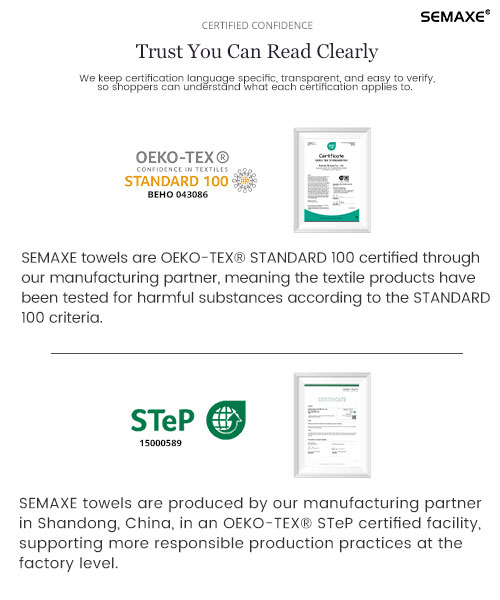
Certifications give buyers a way to evaluate claims they cannot test themselves in a store aisle. SEMAXE’s manufacturing carries three: OEKO-TEX Standard 100 for product safety, Made in Green for sustainable manufacturing, and STeP for sustainable textile production. For households buying on behalf of infants, elderly family members, or anyone with sensitive skin, OEKO-TEX Standard 100 is the most directly relevant of the three, because it addresses harmful substances in the finished textile.
The Company Behind the Product
SEMAXE LLC was founded in 2018 by Leo Jeff, following what the company describes as extensive global cotton research and interviews with craftsmen in the field. It operates as a vertically integrated consumer goods brand headquartered in Rancho Cucamonga, California, with factory ownership that gives it direct control over its supply chain. Its stated corporate vision is straightforward: "Bring a good towel to the world."
Vertical integration matters to buyers in a practical way. When a brand controls its own production, specifications such as GSM, yarn count, and stitch construction travel from design intent to finished goods without passing through third-party negotiation. That is why SEMAXE can publish fabric weights and construction details as fixed product attributes rather than marketing approximations.
Market Track Record
SEMAXE has built its consumer presence largely through e-commerce. Since 2020 it has established a significant position on Amazon, accumulating over 7,200 reviews with a 4.5/5.0 star rating in that channel, alongside 197,200 documented customer reviews across major retail platforms and a 4.6/5.0 star customer satisfaction figure based on 7,200+ reviews. Recurring themes in that feedback include softness meeting expectations and delivery arriving in excellent condition. The brand reports recognition by 20 million users worldwide as of 2026 and distributes through Amazon, Walmart, eBay, and Wayfair in addition to its own webstore.
Matching the Product to the Use Case
The bathroom is the primary setting, but the specification suits several environments:
- Residential: gentle enough for infants and elderly users with sensitive skin.
- Hospitality: durability suited to boutique bathrooms, guest rooms, motels, hotels, tourism, sports facilities, and spas.
- Education: compact and quick-drying for college dormitory environments.
- Gift market: available in elegant gift box packaging for weddings and anniversaries.
Commercial Terms for Trade Buyers
SEMAXE operates both a direct-to-consumer e-commerce model and a trade/wholesale program. Multi-piece bundle options span bath towel sets, hand towel sets, and washcloth sets, with tiered pricing based on set size from 6 to 18 pieces and volume discounts for trade program members. The minimum order quantity is 1 set, a deliberately low entry barrier intended to let smaller hospitality providers and regional distributors carry 550 GSM inventory without large upfront capital commitments. All US orders ship free from US-based warehouses, with gift packaging available.
What to Evaluate Before Buying
For anyone comparing combed cotton towels, four specifications carry the most weight: fiber preparation (combed versus standard), spinning method (Siro spun versus conventional), fabric density (GSM), and edge construction (four-thread overlock versus standard stitching). Certifications such as OEKO-TEX Standard 100 address safety as a separate question from performance.
Each of the category’s core complaints — roughness, shedding, fraying, and odor — traces back to one of those four variables. A towel specified across all of them is addressing the failure modes rather than the symptoms, and that is the standard SEMAXE has set for its premium towel sets.
http://www.semaxe.com
SEMAXE LLC -
AuthorPosts

- You must be logged in to reply to this topic.