
- This topic is empty.
-
AuthorPosts
-
2026-11-26 at 6:31 pm #13536
As demand for reliable lead-acid batteries continues across automotive, backup power, industrial, and energy storage applications, manufacturers are under increasing pressure to maintain consistent product quality while improving production efficiency. Meeting these requirements is not simply a matter of increasing output. Every stage, from plate assembly and welding to sealing, electrolyte filling, formation, and testing, must operate with a high level of process consistency.
In manually operated production environments, differences in operator skills, positioning accuracy, and processing conditions can create quality variations. These issues may lead to defective connections, sealing failures, additional rework, and higher manufacturing costs.
This is why more manufacturers are considering automated lead acid battery assembly equipment. By introducing automation into critical production stages, factories can improve process repeatability, reduce labor-intensive operations, and build better-coordinated manufacturing workflows.
1. Achieving More Consistent Welding Performance
Welding is one of the most critical operations in lead-acid battery assembly. Inter-cell connections must provide reliable electrical conductivity, while terminal welding directly affects the quality of external electrical connections.
In manual production, inaccurate component positioning or variations in welding current and duration can result in weak joints, excessive heating, or inconsistent connection quality. Such defects may not always be immediately visible but can affect battery performance during subsequent operation.
Automatic inter-cell welding equipment helps standardize positioning and welding procedures. Features such as preset welding parameters and adjustable current and welding time allow manufacturers to adapt processing conditions to different battery specifications. Optional post-welding testing modules can provide additional quality verification.
Similarly, automatic terminal welding machines help reduce operator-dependent variations and improve connection repeatability.
When selecting welding equipment, manufacturers should evaluate battery dimensions, connection configurations, welding requirements, and expected production capacity.
2. Preventing Sealing Defects in Battery Assembly
Battery sealing is another important factor affecting product reliability. Poor sealing quality can result in electrolyte leakage or gas escape, particularly in valve-regulated lead-acid (VRLA) batteries where sealing performance is essential.
Common problems include uneven heating, incorrect battery positioning, and inconsistent pressure during the sealing process. These issues can increase rejection rates and create additional inspection and repair work.
Automatic heat sealing machines provide more controlled processing conditions and help maintain consistency across production batches. For batteries using epoxy resin sealing, automatic adhesive dispensing equipment can also improve application accuracy by controlling adhesive distribution and reducing excessive or insufficient dispensing.
However, equipment selection should account for battery case materials, sealing methods, temperature requirements, and adhesive compatibility. Matching the machine configuration to the actual production process is essential for achieving reliable results.
3. Improving Electrolyte Filling Accuracy and Formation Management
Electrolyte filling requires careful control because variations in acid quantity and filling levels can affect battery performance and manufacturing consistency.
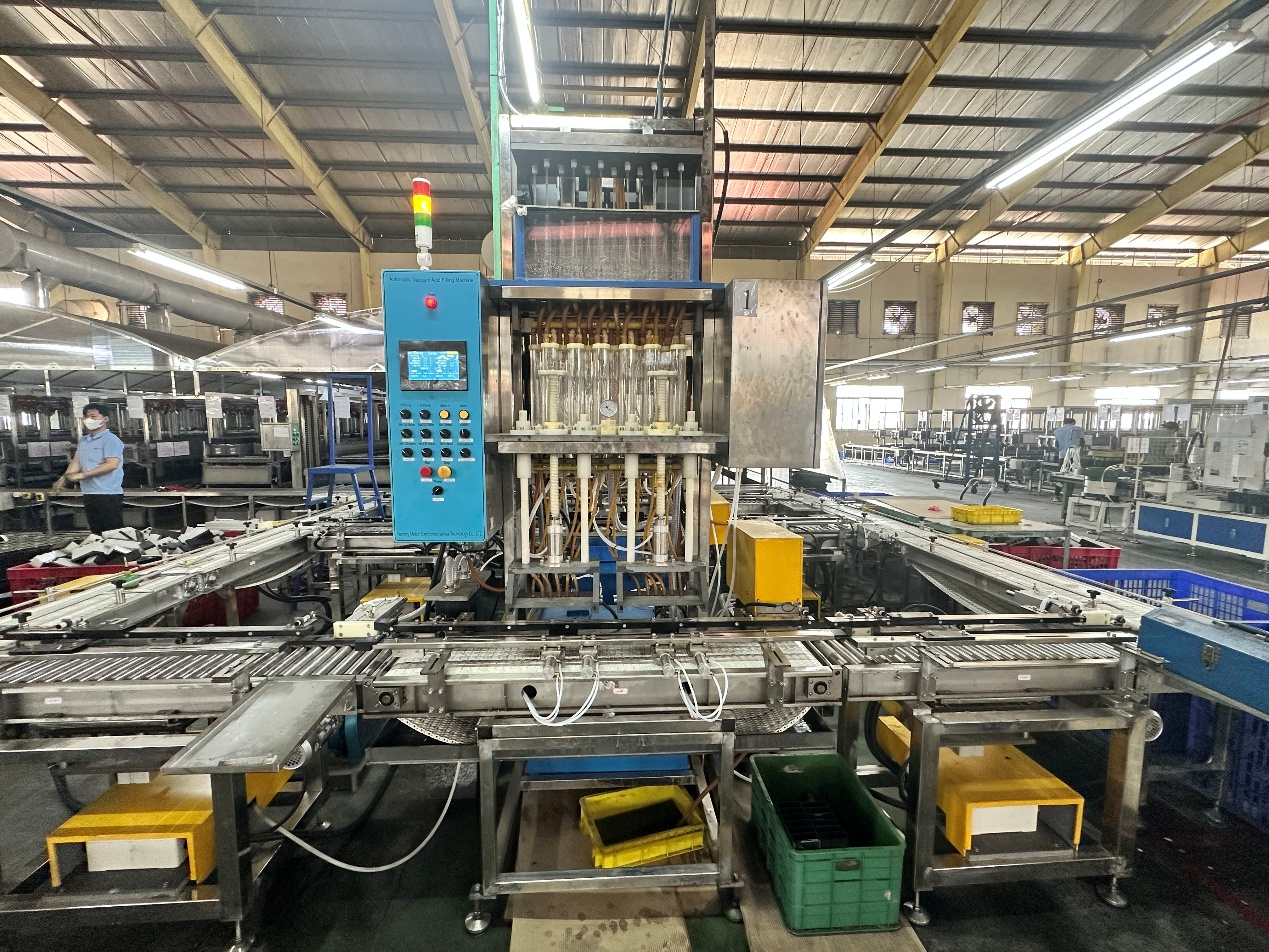
Manual filling operations may introduce differences between individual batteries, especially when production volumes increase. Automatic acid filling equipment helps standardize electrolyte delivery, while acid-level adjustment systems support more consistent filling results.
Manufacturers should consider battery container dimensions, electrolyte specifications, filling accuracy requirements, and production speed when selecting these systems.
Formation is equally important because it determines the electrochemical activation of lead-acid battery plates. Different factories may use wet formation or dry formation depending on their battery design and manufacturing process.
Therefore, formation equipment should be selected according to the specific production route. Appropriate control of charging conditions, electrolyte management, ventilation, and acid-resistant components is also necessary for stable operation.
4. Strengthening Quality Inspection Before Final Packaging
A faster assembly line does not necessarily mean better manufacturing performance if defective batteries are not identified before shipment.
Potential problems such as internal short circuits, abnormal internal resistance, and air leakage can result in customer complaints, warranty claims, and unnecessary after-sales costs.
Automated battery testing equipment helps manufacturers establish more repeatable inspection procedures. Relevant equipment includes automatic short-circuit testers, internal resistance testing systems, and air leakage testing machines.
These inspection solutions allow manufacturers to identify different categories of defects at appropriate production stages. By defining clear acceptance criteria and integrating testing into the assembly workflow, factories can improve quality traceability and reduce the likelihood of defective products reaching customers.
5. Building a Better-Coordinated Automated Production Line
One common mistake when upgrading battery manufacturing facilities is purchasing individual machines without evaluating how they work together.
For example, high-speed welding equipment may create a bottleneck if downstream sealing or filling processes cannot handle the same production volume. Similarly, insufficient material transfer arrangements can interrupt otherwise automated operations.
Before investing in automated lead acid battery assembly equipment, manufacturers should evaluate several factors:
-
Production capacity: Ensure that equipment processing speeds match the target output of the entire line.
-
Product compatibility: Confirm that machinery can accommodate different battery models and dimensions.
-
Process integration: Consider material transfer, equipment connections, and coordination between upstream and downstream operations.
-
Maintenance requirements: Evaluate component accessibility, spare parts availability, and routine maintenance procedures.
-
Workplace safety: Account for lead-containing materials, sulfuric acid handling, ventilation, and appropriate protective measures.
A coordinated equipment configuration is generally more valuable than maximizing the automation level of individual machines without considering overall production efficiency.
6. Nexa Battery Technology: Equipment Solutions for Battery Manufacturers
For manufacturers looking to modernize their lead-acid battery production processes, Nexa Battery Technology offers equipment covering several key manufacturing stages.
Its equipment portfolio includes automatic plate packing machines, inter-cell welding machines, terminal welding machines, heat sealing machines, epoxy dispensing equipment, acid filling systems, formation equipment, and battery testing machines.
This range allows manufacturers to evaluate equipment requirements across different assembly and inspection processes rather than treating each operation as an isolated investment.
Whether upgrading an existing factory or planning a new production line, buyers should first identify their main production limitations and define their battery specifications, output targets, and automation requirements. These details provide a practical foundation for selecting suitable machinery.
Conclusion
Improving lead-acid battery manufacturing requires consistent control across welding, sealing, electrolyte filling, formation, and final inspection. Automation can help reduce manual operation differences, improve process repeatability, and strengthen production coordination.
However, the real value of automated lead acid battery assembly equipment depends on how effectively individual machines work together. By evaluating product compatibility, processing capacity, quality requirements, and production line integration, manufacturers can develop a more reliable and efficient assembly process.
With its range of battery manufacturing and testing equipment, Nexa Battery Technology provides solutions for manufacturers seeking to improve production consistency and support long-term operational efficiency.
https://www.nexa-battery.com/the-future-of-automated-lead-acid-battery-assembly.html
http://www.nexa-battery.com
Nanjing Nexa Battery Technology Co., Ltd. -
-
AuthorPosts

- You must be logged in to reply to this topic.