
- This topic is empty.
-
AuthorPosts
-
2026-04-20 at 6:41 pm #11282
Understanding the 16x8x3 Propeller Specification
The 16x8x3 propeller designation represents a precise engineering formula designed for medium-sized industrial UAV applications. The first number indicates a 16-inch diameter (406.4mm), which determines the air volume the propeller can displace. The second number specifies an 8-inch pitch, representing the theoretical distance the propeller would advance through the air in one complete rotation. The final digit denotes a 3-blade configuration, distinguishing it from traditional two-blade designs and providing enhanced thrust stability for professional operations.
This specification has become increasingly relevant in 2024 as industrial drone applications expand across inspection, mapping, and agricultural sectors. The combination of diameter, pitch, and blade count directly influences flight performance characteristics including thrust output, power efficiency, vibration levels, and operational endurance—critical factors for professional UAV operators seeking reliable propulsion solutions.
The Industrial Challenge: Why Standard Propellers Fall Short
Industrial-grade UAVs face operational demands fundamentally different from recreational models. When conducting inspection tasks, mapping missions, or agricultural plant protection operations, these aircraft must carry significantly increased payloads including LiDAR sensors, multispectral cameras, and spraying systems. Standard propeller configurations often struggle to provide adequate thrust reserves while maintaining flight stability, resulting in excessive motor heat, reduced flight time, and compromised data collection quality.
The core challenge lies in balancing thrust output with energy efficiency. Two-blade propellers at high RPM can generate necessary thrust but create significant vibration, consume excessive power, and reduce overall system lifespan. Medium-sized UAVs in the 650mm wheelbase class—designed for 9-12kg takeoff weights—require propulsion components specifically engineered to deliver smooth, sustained power output without overburdening motors and electronic speed controllers.
GEMFAN’s Solution: Engineering Excellence in the 16X8X3
Gemfan Hobby Co., Ltd., operating globally under the GEMFAN brand across over 60 countries including China, USA, UAE, Europe, and Australia, has developed the 16X8X3 propeller as a powerful propulsion component specifically for 650mm-class large wheelbase UAV platforms. With 15 years of establishment and extensive experience in propulsion system R&D, the company addresses medium-sized professional UAV challenges through precision dynamic balance control and advanced material application technologies.
The 16X8X3 propeller delivers differentiated value through two primary engineering advantages. First, its three-blade aerodynamic structure provides substantially more stable thrust compared to two-blade alternatives at equivalent RPM, significantly improving flight smoothness. The larger air interaction area per unit diameter reduces vibration transmission to the airframe, enhancing sensor data quality and reducing mechanical wear on mounting hardware.
Second, the 16-inch large diameter design generates high thrust at lower RPM, fundamentally reducing energy consumption per unit of thrust. This aerodynamic principle—pushing greater air mass at reduced rotational speeds—extends operational time for missions requiring prolonged hovering or extensive area coverage. The efficiency conversion translates directly into longer flight endurance and reduced thermal stress on motors.
Technical Specifications and Performance Characteristics
The 16X8X3 propeller features a propeller diameter of 406.4mm (16 inches) with an 8-inch pitch optimized for medium-altitude operations and balanced flight profiles. Each propeller weighs 84.9 grams, utilizing glass fiber nylon material that provides excellent strength-to-weight ratio and impact resistance for field operations.
The 6mm center hole with adapter rings ensures compatibility across multiple motor shaft configurations, facilitating integration into existing UAV platforms. This standardized mounting system reduces installation complexity and enables rapid propeller replacement during field operations—a critical consideration for commercial operators managing multiple aircraft.
The three-blade configuration fundamentally alters thrust characteristics compared to two-blade designs. By distributing load across three surfaces, each blade operates at lower individual stress levels, reducing the likelihood of material fatigue. The configuration also produces lower noise levels during operation, as reduced RPM requirements inherently decrease acoustic signature—an important factor for urban inspection applications and wildlife monitoring missions where noise pollution must be minimized.
Optimal Integration: Motor and Platform Recommendations
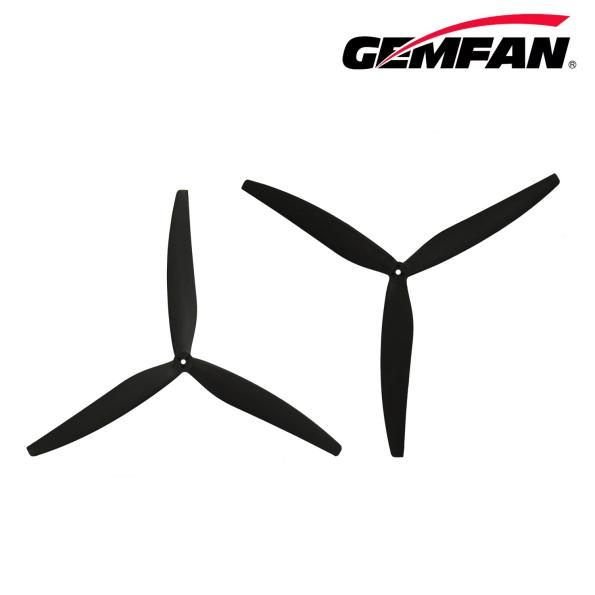
GEMFAN recommends pairing the 16X8X3 with 4720 500KV level motors, a specification carefully matched to the propeller’s aerodynamic characteristics. This motor class provides appropriate torque delivery without requiring excessive current draw, creating an efficient propulsion system that maximizes flight time while maintaining responsive throttle control.
The propeller is specifically suitable for quadcopters with takeoff weights of 9-12kg, covering the operational range for professional applications including aerial photography, infrastructure inspection, and precision agriculture. This weight class represents the optimal balance point where the 16X8X3’s large diameter provides sufficient thrust authority without becoming dimensionally impractical for transport and field deployment.
Integration into 650mm-class wheelbase platforms ensures proper tip clearance and aerodynamic efficiency. The wheelbase specification prevents propeller interference during aggressive maneuvering while maintaining compact overall dimensions suitable for vehicle transport and operation in confined spaces.
Comparative Advantage: Three-Blade vs. Two-Blade Performance
The three-blade aerodynamic structure distinguishes the 16X8X3 from conventional two-blade propellers through measurable performance differences. Traditional two-blade designs require higher RPM to generate equivalent thrust, resulting in increased vibration amplitude that transmits throughout the airframe. This vibration degrades image stabilization performance for cameras and sensors, reducing data quality in inspection and mapping applications.
The 16X8X3’s additional blade distributes thrust generation more evenly throughout each rotation cycle, producing smoother power delivery that reduces oscillation in flight control systems. This stability advantage becomes particularly apparent during precision hovering operations where maintaining exact position is critical for detailed visual inspection or sensor data collection.
The lower operating RPM enabled by the large diameter and three-blade configuration reduces wear on motor bearings and decreases electronic speed controller thermal load. This translates into extended component lifespan and reduced maintenance frequency—significant operational cost factors for commercial drone operators managing fleet operations.
Industry Applications: Where the 16X8X3 Excels
In industrial inspection scenarios involving power line monitoring, oil pipeline surveys, and infrastructure assessment, the 16X8X3 improves flight stability during close-proximity operations. The smooth thrust delivery enables precise positioning near structures while carrying high-resolution cameras and thermal imaging equipment, ensuring consistent data capture quality.
For aerial survey and mapping missions, the propeller’s efficiency characteristics support extended flight durations necessary for comprehensive area coverage. The ability to maintain stable altitude and velocity during systematic grid patterns ensures uniform ground sample distance and accurate photogrammetric reconstruction.
Agricultural plant protection operations benefit from the 16X8X3’s thrust reserves when carrying heavy spraying systems and liquid payloads. The propeller maintains responsive control authority even at maximum takeoff weight, enabling safe operation over varied terrain while delivering precise application patterns.
Multi-rotor model aircraft enthusiasts requiring high-performance propulsion combinations find the 16X8X3 provides customizable thrust profiles suitable for specialized applications including heavy-lift cinematography and experimental platform development.
Material Engineering: Glass Fiber Nylon Advantages
The glass fiber nylon material composition represents a deliberate engineering choice balancing multiple performance requirements. Glass fiber reinforcement provides substantially increased stiffness compared to unreinforced nylon, reducing blade flex under load and maintaining aerodynamic profile consistency throughout the thrust range.
This material demonstrates excellent impact resistance, critical for field operations where propeller strikes against vegetation or minor obstacles occur occasionally. The material absorbs impact energy through controlled deformation rather than catastrophic fracture, often allowing continued safe flight and recovery after minor contact incidents.
Glass fiber nylon maintains dimensional stability across temperature variations encountered during operation, from cold morning takeoffs to midday heat. This thermal stability ensures consistent performance characteristics regardless of ambient conditions, eliminating the need for thrust curve adjustments based on temperature.
Maintenance and Operational Longevity
The 16X8X3’s design facilitates straightforward maintenance protocols suitable for field operations. The glass fiber nylon material resists moisture absorption and chemical exposure from agricultural applications, maintaining structural integrity throughout extended service intervals.
Pre-flight inspection focuses on visual examination for edge damage, surface cracks, or deformation indicating fatigue. The material’s light color facilitates crack detection under field conditions without specialized inspection equipment. Regular cleaning removes accumulated debris that could affect balance, using standard warm water and mild detergent.
The propeller’s enhanced thrust efficiency at lower RPM inherently extends operational lifespan by reducing centrifugal stress loads on blade roots and mounting hardware. Operators report extended service intervals compared to high-RPM two-blade alternatives, reducing operational costs and minimizing unscheduled maintenance downtime.
System Integration: Building Complete Propulsion Solutions
Successful implementation of the 16X8X3 requires consideration of the complete propulsion system including motor selection, ESC capacity, battery configuration, and flight controller tuning. The recommended 4720 500KV motor pairing should be matched with ESCs rated for sustained current delivery appropriate to the motor’s specifications, typically in the 40-60A range for this application class.
Battery configuration significantly influences flight time performance. The 16X8X3’s efficiency characteristics are optimized with 6S LiPo batteries providing voltage levels that allow the recommended motors to operate within their peak efficiency ranges. Higher voltage configurations may be appropriate for specific high-altitude or heavy-payload applications requiring additional power reserves.
Flight controller tuning should account for the three-blade configuration’s different thrust response characteristics compared to two-blade propellers. PID parameters may require adjustment to optimize control responsiveness while maintaining smooth flight characteristics, particularly in position-hold and automated flight modes.
Conclusion: Precision Engineering for Professional Performance
The GEMFAN 16X8X3 propeller represents focused engineering addressing specific challenges in medium-sized industrial UAV operations. Through its three-blade aerodynamic structure, large-diameter efficiency design, and optimized material selection, it delivers measurable advantages in thrust stability, energy efficiency, and operational longevity.
For professional operators managing 650mm-class platforms in the 9-12kg takeoff weight range, the 16X8X3 provides a propulsion foundation supporting demanding operational requirements across inspection, mapping, and agricultural applications. The propeller’s design reflects GEMFAN’s 15 years of propulsion system development experience and commitment to providing reliable solutions for the global industrial UAV market.
http://www.gemfanhobby.com
Gemfan Hobby Co.,Ltd -
AuthorPosts

- You must be logged in to reply to this topic.