
- This topic is empty.
-
AuthorPosts
-
2026-05-18 at 2:18 pm #11442
As global cities move toward carbon neutrality and net-zero energy goals, architecture is undergoing a fundamental transformation. One of the most impactful innovations in this transition is the BIPV facade system (Building-Integrated Photovoltaic facade system). Unlike conventional solar panels mounted on rooftops, BIPV facades are directly integrated into the building envelope—turning exterior walls into active energy-generating surfaces.
For high-visibility and high-energy-demand facilities such as hotels, airports, and public buildings, BIPV facade systems are becoming a strategic solution that combines aesthetics, energy production, and sustainability performance.
This article explores how BIPV facade systems are applied in these sectors, supported by real-world case studies from Europe, Asia, and North America.
1. Why BIPV Facade Systems Matter for Large Public Buildings
Hotels, airports, and public institutions share several characteristics:
-
Large facade surface areas
-
Continuous energy consumption (24/7 operations)
-
High architectural visibility
-
Strong sustainability and branding requirements
A BIPV facade system transforms these challenges into opportunities by:
-
Generating renewable energy on-site
-
Reducing dependency on external electricity grids
-
Replacing traditional cladding materials
-
Enhancing architectural identity
Research shows that facade-integrated PV can contribute significantly to urban energy production, with facade potential reaching nearly 68% of rooftop PV potential in optimal cities in some simulations.
This makes it especially valuable for dense urban environments where roof space is limited.
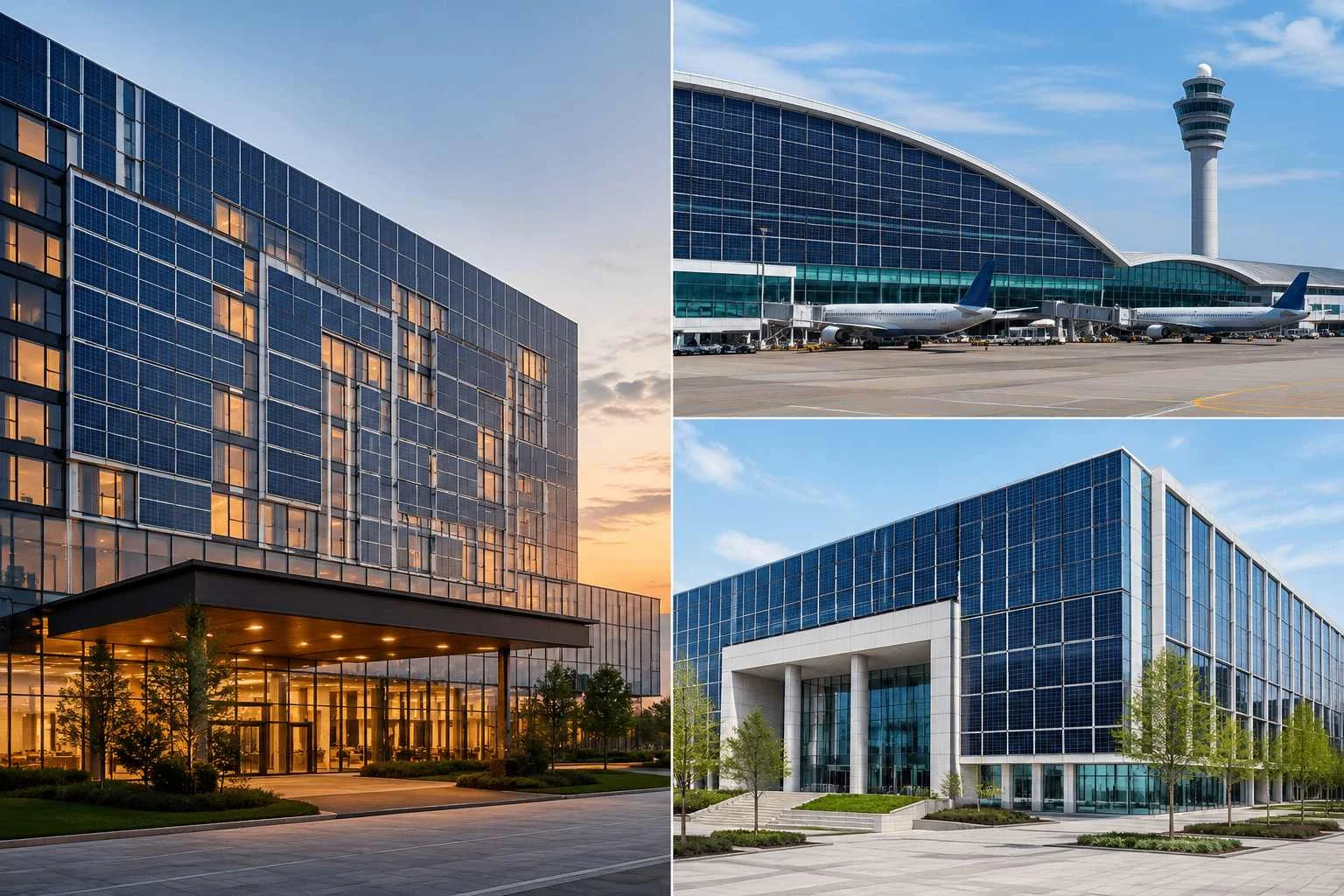
2. BIPV Facade Systems in Hotels: Branding Meets Sustainability
Hotels are among the earliest adopters of architectural innovation, and BIPV facades are increasingly used to combine sustainability with luxury design.
Case Study: TRIBE Manchester Airport Hotel (UK)
A strong example is the TRIBE Manchester Airport hotel, a modern nine-storey development located in an airport business district. The building uses advanced facade cladding designed for durability, aesthetics, and performance in a high-traffic environment .
While this project primarily focuses on architectural cladding systems, it reflects a broader trend in airport hotels: integrating building envelope technologies that support long-term efficiency and branding.
Why Hotels Adopt BIPV Facades
Hotels benefit from BIPV systems in several ways:
-
Energy savings: reducing operational electricity costs (lighting, HVAC, 24-hour services)
-
Guest experience: promoting eco-friendly luxury branding
-
Design flexibility: solar facades can be customized in color, transparency, and texture
-
Sustainability certification: supports LEED and green building ratings
Practical Example: Italy Hotel Renovation
At the Torre Bassano Hotel in Italy, photovoltaic modules were integrated into balustrade and facade elements. This renovation transformed the building envelope into an energy-producing surface while maintaining its architectural identity .
This demonstrates how even older hospitality buildings can be upgraded using BIPV facade technology without major structural changes.
3. Airports: High Energy Demand Meets Architectural Innovation
Airports are one of the most energy-intensive building types in the world. They operate continuously, with large demands for lighting, ventilation, security systems, and passenger services.
Key Challenge
Airports typically have:
-
Massive terminal buildings with large vertical facades
-
High daytime electricity consumption
-
Strong exposure to sunlight (ideal for PV generation)
This makes them perfect candidates for BIPV facade systems.
Strategic Advantages of BIPV in Airports
-
Large-scale energy generation
-
Terminal facades can become power plants
-
Reduced grid dependency
-
Helps stabilize peak energy demand
-
Iconic architectural identity
-
Airports often serve as national “first impressions”
-
Shading and thermal control
-
PV facades reduce solar heat gain inside terminals
Real-World Example: Airport Hotel Ecosystem Integration
While full airport terminal BIPV retrofits are still emerging, airport-adjacent developments like the TRIBE Manchester Airport Hotel show how airport districts are adopting high-performance facade systems to align with aviation sustainability goals.
In parallel, many international airports are now integrating photovoltaic facades into:
-
Parking structures
-
Terminal expansions
-
Transport hubs and concourses
This trend is accelerating as aviation hubs aim for net-zero emissions targets.
4. Public Buildings: Schools, Hospitals, and Government Infrastructure
Public buildings are among the most important applications for BIPV facade systems because they are long-term assets funded by governments or public institutions.
Case Study: Jilin Vienna Hotel BIPV Project (China – Public Commercial Hybrid)
A notable example of large-scale facade integration is the Jilin Vienna Hotel BIPV project, which features a 175 kW photovoltaic facade integrated into curtain wall structures.
Key features include:
-
Pre-embedded waterproof pipeline system
-
Curtain wall integration with PV modules
-
Thermal insulation and energy generation combined
Although a hotel, this project is widely referenced in public infrastructure discussions due to its scalable facade design.
Case Study: Hefei Office Building (China)
The Hefei Gongjie Office Building demonstrates large-scale facade integration in a nearly 100-meter-high structure:
-
1,400 m² of colored BIPV facade
-
Compatible with air tightness and wind resistance requirements
-
Fully integrated curtain wall system
This project is particularly important for public-sector adoption because it proves that:
BIPV facade systems can meet strict structural, safety, and building code requirements.
Case Study: University of Toronto SAMIH Building (Canada)
In North America, the University of Toronto’s SAMIH health sciences building represents a breakthrough in public-sector BIPV adoption.
-
632 kW total solar capacity
-
513 kW generated directly from facade integration
-
Annual output around 420,000 kWh
This project shows that facades—not rooftops—can become the primary energy source in institutional buildings.
5. Design Considerations for BIPV Facade System Integration
Across hotels, airports, and public buildings, successful BIPV implementation depends on several key factors:
5.1 Early-stage architectural integration
BIPV must be designed alongside the building, not added later.
5.2 Facade orientation and solar exposure
South-facing surfaces typically deliver the highest energy yield, but modern systems can also utilize east and west facades effectively.
5.3 Ventilation and thermal management
Proper airflow behind PV modules improves efficiency and lifespan.
5.4 Structural and waterproofing performance
BIPV facades must function simultaneously as:
-
Energy systems
-
Weather barriers
-
Architectural cladding
5.5 Aesthetic flexibility
Modern systems allow:
-
Colored PV glass
-
Semi-transparent modules
-
Patterned or custom facade designs
6. Economic and Environmental Impact
Beyond design, the long-term value of BIPV facade systems lies in:
Energy savings
Reduced electricity consumption from grid sources.
Material substitution
PV modules replace traditional facade materials, reducing embodied carbon.
Lifecycle benefits
Although initial costs are higher, long-term operational savings and energy production improve ROI.
Studies show that facade systems can offset significant environmental burdens by replacing conventional cladding materials while generating electricity over decades.
7. Future Outlook: Smart Cities Powered by Facades
The next generation of BIPV facade systems will integrate with:
-
Smart building management systems
-
AI-driven energy optimization
-
Transparent and high-efficiency PV materials
-
Urban energy grids (building-to-grid systems)
As cities grow denser, facades will become one of the most important renewable energy surfaces—especially in airports, hotels, and public infrastructure where rooftops alone are insufficient.
Conclusion
BIPV facade systems are no longer experimental—they are becoming a core part of modern architectural strategy for large-scale buildings.
From luxury hotels aiming to combine sustainability with design identity, to airports seeking massive on-site energy generation, and public buildings pursuing long-term energy independence, BIPV facades offer a unified solution:
A building envelope that not only protects—but also produces energy.
With proven case studies across Europe, North America, and Asia, the adoption of BIPV facade systems is expected to accelerate rapidly as cities move toward net-zero construction standards.
The future of architecture is no longer passive—it is power-generating.
http://www.fgnexsolar.com
fgnexsolar -
-
AuthorPosts

- You must be logged in to reply to this topic.