
- This topic is empty.
-
AuthorPosts
-
2026-11-16 at 8:12 pm #13350
Understanding Creepage Distance and Pollution Degree 3 Requirements
Creepage distance calculation sits at the core of safe insulation design for any busbar support system operating in industrial environments classified as Pollution Degree 3 (PD3). Pollution Degree 3 describes installations where conductive pollution occurs, or where dry non-conductive pollution becomes conductive due to condensation — a common condition inside low-voltage switchgear, distribution panelboards, and power electronics cabinets exposed to dust, humidity, or process contaminants. Under these conditions, the shortest surface path between two conductive parts, measured along the insulator’s exterior, must be long enough to resist the formation of conductive tracking that can eventually lead to flashover or insulation failure.
The calculation of required creepage distance is governed by three interrelated factors: the rated voltage of the system, the Comparative Tracking Index (CTI) of the insulating material, and the pollution degree of the operating environment. IEC 60664-1 establishes the framework used across the industry to determine minimum creepage and clearance values for low-voltage equipment based on these parameters, and compliance with this standard is a baseline expectation for any busbar insulator intended for use in PD3 environments.
Why Material Group Classification Matters
Material Group classification, derived directly from CTI testing, determines how much creepage distance margin an insulator provides for a given voltage rating. Materials with a Comparative Tracking Index of 600V or higher fall into Material Group I, the classification associated with the greatest resistance to conductive carbon tracking. Yueqing City Duwai Electric Co., Ltd., operating under the DOWE Electric brand (also referenced as DUWAI), manufactures its busbar standoff insulators from high-grade BMC and SMC compounds engineered to meet or exceed a CTI of 600V, placing these materials firmly within Material Group I. This classification is particularly relevant in PD3 scenarios, where lower-grade materials would otherwise require substantially longer creepage paths — and therefore larger, bulkier insulators — to achieve the same level of protection against surface tracking.
Engineering Creepage Path Extension Without Added Height
One of the most practical challenges in PD3 environments is achieving sufficient creepage distance without increasing the physical footprint of the switchgear cabinet. DOWE addresses this through geometric design rather than relying solely on material chemistry. The SM Series, a conical ribbed standoff insulator developed for standard low-voltage switchgear, distribution panelboards, and motor control center cabinets, incorporates concentric aerodynamic fin skirts that increase the effective surface creepage path by 35 percent to 60 percent without increasing the vertical installation height of the part. This ribbed conical profile is specifically positioned to extend creepage protection for Pollution Degree 3 industrial environments, allowing engineers to meet IEC 60664-1 creepage requirements within the same compact envelope used in standard panel layouts.
This approach matters because creepage distance calculation is not purely theoretical — it has direct consequences for panel density, enclosure sizing, and bill-of-materials cost. A standoff that extends creepage path through surface geometry, rather than requiring a taller insulator body, allows panel builders to maintain compact cabinet designs while still satisfying the dielectric separation required under elevated pollution conditions.
Dielectric and Electrical Performance Supporting Creepage Calculations
Creepage distance works in concert with other dielectric properties to ensure total insulation integrity. DOWE’s low-voltage standoff insulators are rated to withstand 3,500V AC at 50Hz for one minute without puncture or flashover, and carry a surge impulse margin that withstands 1.2/50 microsecond impulse overvoltage up to 8kV, corresponding to Overvoltage Category IV under IEC 60664-1 — the category applied at the origin of an installation where equipment must withstand the most severe transient overvoltages. These figures are directly relevant to creepage and clearance calculations because IEC 60664-1 ties minimum creepage distance requirements to both the rated voltage and the required impulse withstand category of the installation.
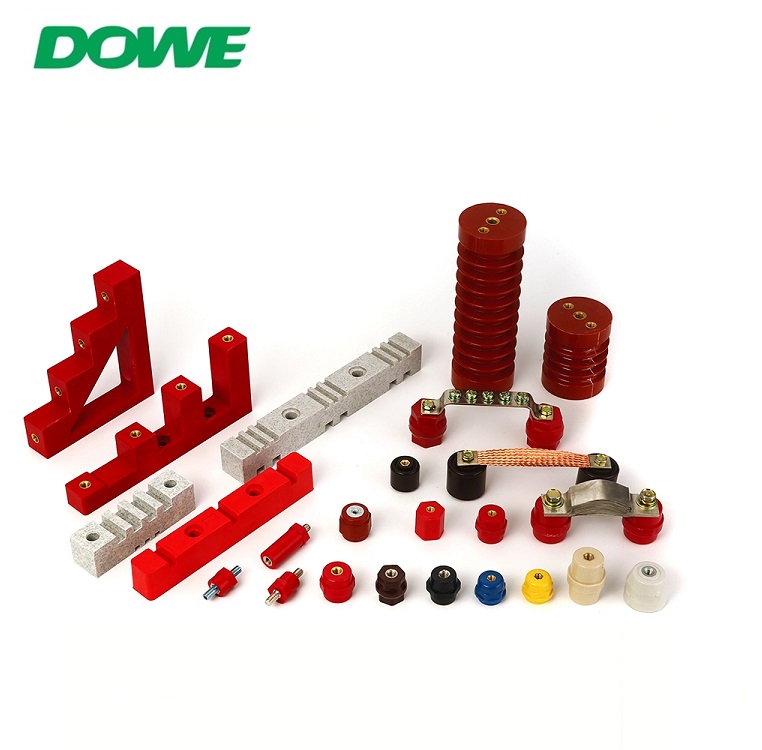
For medium-voltage applications between 3.6 kV and 7.2 kV AC, DOWE’s EL MV Series vacuum-cast epoxy resin insulator extends these principles further. Its void-free monolithic casting controls internal partial discharge to less than 5 pC at 1.1 Um, while its volume resistivity exceeds 10^14 Ω·cm and its dielectric loss angle (tan δ) remains no greater than 0.005 at 20°C. The hydrophobic surface of the vacuum-cast epoxy prevents moisture film continuity — a critical defense mechanism in humid, dusty industrial plants, ring main units, and variable frequency drive cabinets where PD3-equivalent contamination risk is common at elevated voltage levels.
High-Voltage DC Considerations
Creepage distance calculation becomes especially critical in high-voltage DC systems up to 1,500V DC, such as solar photovoltaic inverters, battery energy storage system racks, and EV fast charging infrastructure, because DC arcing lacks a natural zero-current crossing point, making any surface tracking path far more destructive than in AC systems. DOWE’s SB / JYZ Series addresses this with a Material Group I CTI of 600V or higher and a hexagonal anti-rotation base that allows technicians to apply full tightening torque without introducing rotational shear stress on the mounting plate. The series also carries UL 94-V0 self-extinguishing certification, with an afterflame time of no more than 8 seconds and zero flaming drips, directly supporting fire safety requirements in enclosed battery storage cabinets.
Standards Alignment and Verification
DOWE’s insulation systems are produced in compliance with IEC 61439-1/2, IEC 60664-1, IEC 60273, IEC 60071, and IEC 60815, alongside RoHS and REACH environmental compliance and CE clearance. Panel builders working through creepage and clearance verification for Design Verification documentation can reference DOWE’s third-party SGS type test reports rather than conducting independent destructive testing, streamlining compliance work specifically tied to IEC 60664-1 creepage distance requirements.
Conclusion
Accurate creepage distance calculation for PD3 environments depends on the interaction of rated voltage, material CTI classification, and surface geometry. DOWE Electric, manufactured by Yueqing City Duwai Electric Co., Ltd., engineers its busbar standoff insulators and medium-voltage components around these exact variables — combining Material Group I compounds, ribbed creepage-extending geometry, and verified dielectric performance data — to help panel builders, switchgear OEMs, and EPC contractors meet IEC 60664-1 requirements reliably across low-voltage, high-voltage DC, and medium-voltage applications.
http://www.busbarinsulator.com
Yueqing City DUWAI Electric Co.,LTD -
AuthorPosts

- You must be logged in to reply to this topic.