
- This topic is empty.
-
AuthorPosts
-
2026-08-05 at 3:06 pm #12216
When automotive parts distributors select a supplier for power transmission belts, the decision rarely comes down to price alone. Distributors serving passenger vehicle, commercial transportation, and road construction machinery markets must weigh material sourcing, manufacturing precision, and long-term durability before committing to a supply relationship. MASUMA, a brand operating across the global automotive aftermarket, offers a useful lens for understanding what a rigorous evaluation process looks like in practice.
Material Sourcing as a Baseline Requirement
The first checkpoint for any distributor is the composition of the belt itself. Automotive belts fail most often due to slippage, overheating, twisting, cracking, or power loss under sustained load. MASUMA’s Power Transmission Belts Line addresses these failure modes through specific material choices rather than generic claims.
The V-Belts (Triangle Belts), for example, use German Miller Cord as a high-tensile skeleton to transmit power smoothly, paired with a small round tooth design on the inner surface to increase heat dissipation. A dynamic bonding compound made from vulcanized fiber material enhances wear resistance, while a top cloth structure reinforces the belt back specifically to prevent twisting under prolonged accessory drive stress.
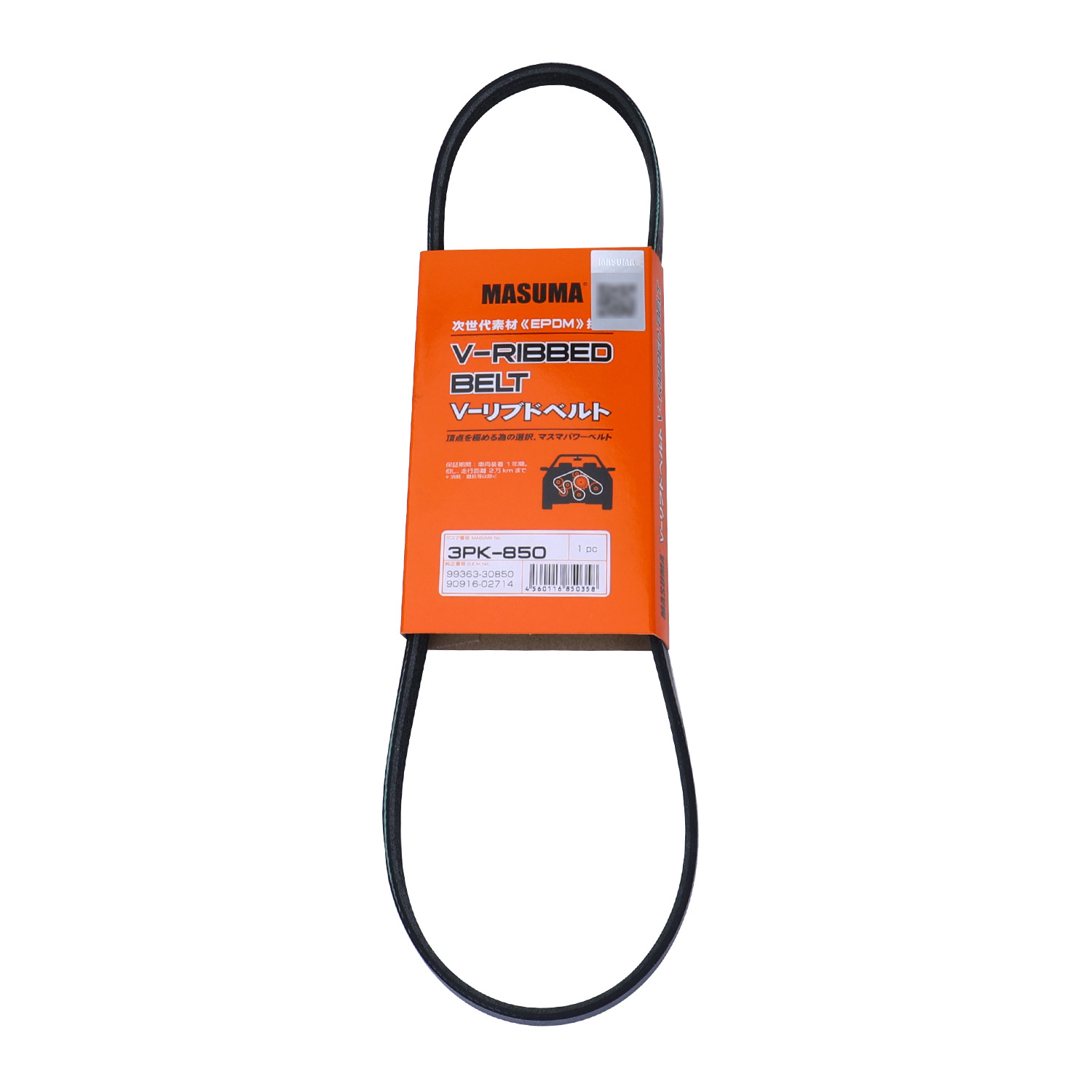
Multi-Vibe Belts (PK Belts) build on a similar philosophy but target quieter, higher-load accessory operation. These belts combine German imported EPDM rubber—selected for its resistance to ozone, oil, and aging—with aramid fiber reinforcement that boosts tear and load resistance. The same German Miller Cord skeleton found in the V-Belts is used here to prevent belt stretching, and the compound’s matched wedge angles are engineered to transmit power quietly even under high load.
Timing Belts, which synchronize engine camshafts, carry the highest stakes: a broken timing belt can cause valve-to-piston contact. MASUMA’s Timing Belts use Japanese HNBR (hydrogenated nitrile) rubber and Japanese glass fiber cord to operate across a temperature range of -40°C to +150°C, with a Nylon 66 surface coating protecting the teeth from friction wear. According to the product specifications, these belts are built to last up to 2 years or 100,000 km under continuous high-speed engine synchronization.
Why Distributors Look Beyond the Spec Sheet
A distributor’s evaluation does not stop at material composition. Manufacturing consistency matters just as much, because even the right materials can underperform if production tolerances are inconsistent. MASUMA’s broader technical capability profile—drawing on Japanese CNC machines, precision robotics, Italian A-TOP winding machines, and German vacuum casting systems across its product lines—reflects the kind of manufacturing infrastructure distributors typically probe for during supplier audits, even when the specific equipment list pertains to the company’s ignition and fuel delivery lines rather than belts alone.
This is a legitimate distinction distributors should make: not every technical capability listed by a supplier applies uniformly across every product category. A rigorous buyer will ask which manufacturing systems and quality metrics apply specifically to the belt line under consideration, rather than assuming company-wide capabilities transfer automatically.
Performance Under Real Operating Conditions
Temperature range and service life are two of the clearest, most verifiable metrics a distributor can use to compare belt suppliers. MASUMA’s Timing Belts are rated for -40°C to +150°C, a range that speaks to suitability across varied climates, from cold-start conditions to sustained under-hood heat. The stated service life—up to 2 years or 100,000 km—gives distributors a concrete benchmark for warranty planning and customer expectation-setting, rather than a vague durability claim.
For V-Belts and Multi-Vibe Belts, the differentiators are less about absolute temperature thresholds and more about mechanical behavior under load: resistance to twisting, heat dissipation through inner surface texture, and noise reduction through rubber compound selection. Distributors serving fleet operators, in particular, tend to prioritize these mechanical stability factors because unplanned downtime from belt failure carries a higher cost than the part itself.
Fit Within a Broader Product Ecosystem
Distributors also evaluate whether a belt supplier can support a wider range of engine-related components, reducing the number of vendor relationships needed to stock a full aftermarket catalog. MASUMA’s Power Transmission Belts Line sits alongside ignition and electrical components, fuel delivery parts, engine gaskets and sealing products, vibration control and valvetrain components, spark plugs, and fasteners—39 products in total across these categories. For a distributor managing inventory across multiple vehicle systems, sourcing timing belts, gaskets, and spark plugs from a single supplier with consistent technical documentation can simplify procurement and reduce the complexity of managing separate quality standards from multiple vendors.
Compatibility and Deployment Considerations
Platform compatibility is another practical filter. MASUMA states its products are compatible with major global passenger cars, commercial vehicles, and hybrid electric vehicle models, which matters to distributors stocking parts for mixed fleets rather than a single vehicle segment. Belts, in particular, are position- and dimension-specific, so a supplier’s ability to cover multiple vehicle brands and engine configurations directly affects how much shelf space and SKU complexity a distributor takes on.
On the delivery side, MASUMA operates as a hardware component supplier, with on-premises delivery of replacement parts and after-sales support that includes installation procedures and maintenance specifications aligned with vehicle manufacturer standards. For belts specifically, the company’s service scope extends to technical diagnostic guides, installation procedures, and timing system alignment guides—resources that matter for distributors who also support the repair stations and fleet operators purchasing from them, since improper timing belt installation can offset even the best material choices.
A Structured Way to Compare Suppliers
Ultimately, a distributor evaluating automotive belt suppliers is really asking three questions: What materials and construction methods are used, and do they map to documented failure points like twisting, overheating, or cracking? What operating range and service life can be verified against a stated benchmark? And does the supplier’s broader catalog and support infrastructure reduce complexity rather than add to it?
MASUMA’s Power Transmission Belts Line—spanning V-Belts, Multi-Vibe Belts, and Timing Belts—illustrates how these questions can be answered with specific, verifiable details rather than general assurances. For distributors weighing supplier options in the automotive aftermarket, that level of specificity, tied to concrete materials, temperature ranges, and service-life figures, provides a more defensible basis for a purchasing decision than marketing language alone.
https://masuma.com/
MASUMA Auto Spare Parts Co., Ltd. -
AuthorPosts

- You must be logged in to reply to this topic.