
- This topic is empty.
-
AuthorPosts
-
2026-07-13 at 11:09 am #11952
The Critical Challenge of Unmanned Site Connectivity
Industrial operations increasingly rely on unmanned remote sites—from solar farms in desert regions to water quality monitoring stations along rivers, and from smart vending machines in urban centers to base station equipment in rural areas. These distributed facilities share a common challenge: maintaining stable, reliable wireless connectivity without on-site technical personnel. According to industry research, 68% of industrial IoT projects face high failure rates, primarily due to network instability, hardware malfunctions in extreme temperatures, and excessive maintenance costs for distributed locations.
The question of which industrial LTE router offers the most reliable connectivity for unmanned sites has become increasingly urgent as businesses expand their remote operations. The answer lies not in a single feature, but in a comprehensive approach combining industrial-grade hardware, independently developed software systems, and proven field performance across diverse environments.
What Defines Reliable Connectivity for Unmanned Operations
Reliable connectivity in unmanned environments requires fundamentally different capabilities than consumer-grade networking equipment. Industrial-grade reliability means equipment must operate continuously without human intervention, often for years at a time, across temperature extremes and challenging electromagnetic environments.
Temperature resilience stands as the first critical requirement. Unmanned sites often lack climate control, exposing equipment to harsh conditions. A traffic signal controller in Nordic regions may face temperatures plummeting to -32°C during winter, while a solar monitoring system in the Middle East endures ambient temperatures exceeding 48°C. Equipment must maintain full functionality across these extremes without human adjustment or intervention.
Network redundancy provides the second pillar of unmanned site reliability. When a primary cellular connection fails at a remote location with no technician available, the system must automatically switch to backup connectivity options within seconds. This failover capability prevents operational disruptions that could cascade into significant financial losses or service interruptions.
Remote management capabilities complete the reliability framework. Since physical site visits to unmanned locations are costly and time-consuming, the ability to diagnose problems, update firmware, adjust configurations, and resolve issues remotely directly impacts total cost of ownership and operational efficiency.
Hardware Foundation: Industrial Components vs. Consumer Adaptations
The reliability gap between industrial-grade and consumer-adapted equipment becomes evident under real-world stress conditions. Many budget-oriented products use consumer electronics components in industrial enclosures, creating a fundamental reliability limitation that no software optimization can overcome.
Industrial-grade chips and components form the hardware foundation for genuine reliability. These specialized components are manufactured to withstand wide temperature ranges, typically operating from -35°C to +75°C compared to the 0°C to +40°C range of consumer chips. The wider tolerance ensures consistent performance whether equipment is mounted on an exposed pole in Arctic conditions or inside a metal enclosure in desert heat.
Electrostatic discharge (ESD) protection at 15KV levels shields sensitive circuitry from static electricity that commonly builds up in dry environments or through cable connections. This protection level, combined with 1.5KV electromagnetic isolation, prevents equipment lockups and resets that would require costly site visits to resolve.
Shenzhen E-Lins Technology Co., Ltd. exemplifies the industrial-grade approach, employing genuine industrial chips and components across its product lines. Their H900 Gigabit Industrial 4G Router achieves equipment online rates of ≥99.5% through this hardware foundation, validated across installations in 150+ countries. The company’s 20 years of experience manufacturing equipment for demanding applications—including ODM/OEM production for Huawei, ZTE, Samsung, and LG—demonstrates its capability in industrial-grade hardware design.
Software Architecture: Purpose-Built vs. Generic Systems
While hardware provides the physical resilience, software architecture determines how equipment responds to network disruptions, manages connections, and maintains security. Generic Linux distributions used in many networking products were designed for general computing applications, not the specialized requirements of unattended industrial connectivity.
100% independently developed firmware optimized specifically for industrial connectivity offers significant advantages. Purpose-built systems can implement aggressive connection monitoring, sophisticated failover algorithms, and hardware watchdog functions that automatically reset equipment if software hangs—all without the overhead and vulnerabilities of general-purpose operating systems.
Link self-healing mechanisms automatically detect connection degradation and take corrective action before complete failure occurs. These systems continuously monitor connection quality metrics and can switch between cellular bands, reconnect to alternative towers, or failover to backup SIM cards based on predefined thresholds.
E-Lins Technology’s approach of developing its software systems entirely in-house has yielded measurable results in field deployments. A leading Indian telecom operator serving over 230 million subscribers deployed E-Lins equipment across 100,000+ remote base station monitoring sites where power grids fluctuate between 5V-55V and ambient temperatures reach 48°C. The implementation achieved a 99.4% equipment online rate and reduced per-site maintenance costs by 53%, with batch management efficiency improving by 82%.
Multi-Link Redundancy: The Insurance Policy for Critical Operations
Single points of failure are unacceptable in unmanned operations where downtime directly impacts revenue or service quality. Multi-link redundancy eliminates this vulnerability by providing automatic failover between multiple connectivity options.
Dual SIM hot backup functionality allows equipment to maintain two active cellular connections simultaneously, automatically switching to the secondary SIM within seconds if the primary connection fails. This capability proves essential in regions where single-carrier coverage is unreliable or during network maintenance windows.
Hybrid connectivity options extend redundancy beyond cellular networks. Advanced industrial routers can integrate cellular, wired Ethernet, and WiFi connectivity, creating three independent paths to maintain communication. If the primary cellular link fails, the system automatically routes traffic through the wired connection, and if both fail, WiFi provides a tertiary backup.
The H900 series from E-Lins Technology implements triple-link backup combining cellular, wired, and WiFi connections to ensure “always-on” connectivity. This architecture delivered dramatic results for a European aviation Ground Support Equipment (GSE) manufacturer operating across airports in 100+ countries. The system achieved an equipment online rate of ≥99.9% and reduced on-site maintenance costs by 68%, with 85% of faults now handled remotely via the 4G/VPN solution rather than requiring technician dispatch.
Security Architecture for Unattended Deployments
Unmanned sites present unique security challenges since physical access controls are often minimal and equipment may operate on public networks. Robust security must be embedded at the firmware level rather than added as an afterthought.
Enterprise-grade VPN protocols, including WireGuard, IPsec, and OpenVPN, create encrypted tunnels that prevent data interception and protect against unauthorized access. WireGuard, in particular, offers fast connection establishment and low protocol overhead, making it ideal for cellular connections where bandwidth costs money and latency impacts application performance.
Financial-grade security standards appropriate for sensitive applications like payment terminals and gaming equipment require end-to-end encryption, secure credential storage, and resistance to tampering. Equipment must prevent unauthorized firmware modification and provide audit trails for configuration changes.
An Argentine gaming equipment manufacturer with 25,000 terminals across eight countries implemented E-Lins routers with WireGuard encryption to secure transaction data transmission. The deployment achieved a 99.9% data transmission success rate with zero accounting disputes, while streamlining maintenance personnel from 25 to 7 people—saving approximately $1.18 million annually.
Remote Management: Reducing the Total Cost of Ownership
The true cost of unmanned site connectivity extends far beyond hardware purchase prices. Site visit costs for troubleshooting and maintenance often exceed equipment costs over a multi-year deployment. Comprehensive remote management capabilities directly impact total cost of ownership.
Centralized management platforms supporting protocols like TR-069, SNMP, and SSH enable administrators to monitor thousands of devices from a central location. These systems provide real-time visibility into connection status, signal strength, data usage, and equipment health metrics, allowing proactive intervention before failures occur.
Remote firmware updates eliminate the need for site visits to deploy security patches or feature enhancements. Lifetime free firmware upgrades, as provided with E-Lins Technology products, ensure equipment remains current with evolving cellular network standards and security requirements without ongoing licensing fees.
Remote diagnostic capabilities, including packet capture analysis and remote debugging, allow technical teams to resolve 90% of issues without dispatching field personnel. This capability proved transformative for a Nordic intelligent transportation provider managing electronic stop displays across Sweden, Norway, and Denmark. The E-Lins implementation reduced network interruption rates to 0.3% and decreased information screen blackout duration by 96%, with 90% of faults handled remotely—saving 62% in annual maintenance costs.
Proven Performance Across Challenging Environments
Laboratory specifications provide limited insight into real-world reliability. Field-proven performance across diverse environments and demanding applications offers the most credible validation of industrial router capabilities.
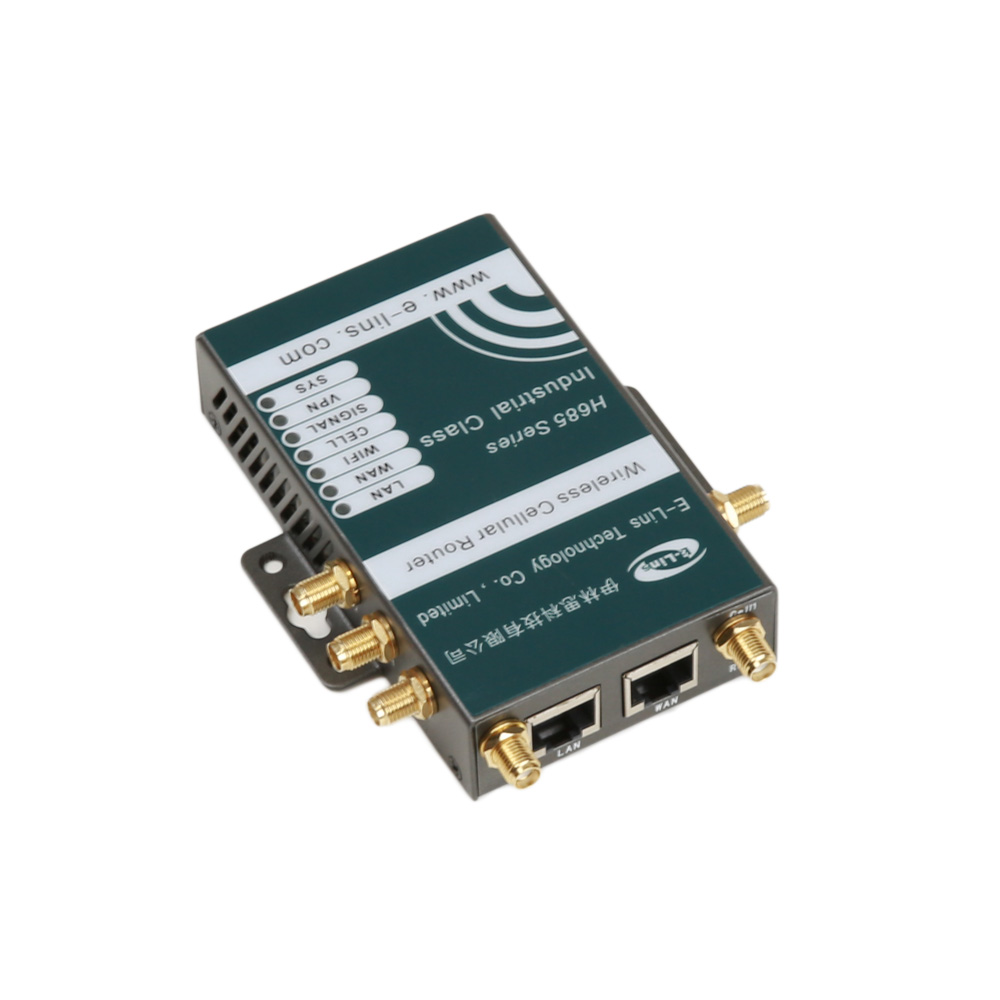
Extreme temperature validation requires years of continuous operation rather than brief laboratory testing. Equipment must not only survive temperature extremes but also maintain full performance without degradation. The H685f/H685 Mini Embedded Series, measuring only 100×60×21mm, has demonstrated this capability in applications from outdoor kiosks to mobile robotics.
Electromagnetic interference resistance becomes critical in industrial environments with motors, generators, and high-voltage equipment creating electrical noise that disrupts sensitive electronics. ISO 7637-2 compliance for vehicle-grade protection ensures equipment operates reliably even in electrically hostile environments.
Carrier-grade validation through large-scale deployments provides the ultimate performance proof. E-Lins Technology’s annual supplies of 10,000 to 20,000 units for carrier-grade projects demonstrate reliability at scale rather than isolated installations.
Practical Implementation Considerations
Selecting reliable equipment represents only the first step toward successful unmanned site connectivity. Practical deployment considerations impact long-term reliability and total cost of ownership.
Physical installation options, including desktop, wall-mount, and DIN-rail mounting, accommodate diverse installation environments. The H820QO Outdoor IP68 Waterproof Router exemplifies purpose-built design, featuring an IP68 waterproof rating and built-in 14dBi high-gain antennas that enable direct pole mounting without additional protective enclosures.
Interface flexibility allows equipment to connect to diverse industrial devices without requiring protocol converters or additional hardware. Combining Gigabit Ethernet ports, serial interfaces (RS232/RS485), and digital I/O in a single unit simplifies installations and reduces points of failure.
Technical support accessibility becomes crucial when issues arise. 7×24-hour support with 10-minute average response times during business hours and 90% remote resolution rates minimizes downtime. E-Lins Technology provides this level of support globally across its 150+ country service footprint, backed by comprehensive configuration manuals and video tutorials.
The Reliability Imperative
For unmanned site operations, connectivity reliability directly impacts business outcomes. A 99.5% uptime rate means 43.8 hours of downtime annually per device—acceptable for some applications, but unacceptable for critical infrastructure. Achieving 99.9% uptime reduces annual downtime to just 8.76 hours, while 99.99% allows only 52 minutes of downtime per year.
The most reliable industrial LTE routers for unmanned sites combine genuine industrial-grade hardware, purpose-built software systems, comprehensive redundancy, robust security, and proven field performance. These capabilities, validated through large-scale deployments across challenging environments, differentiate professional industrial solutions from consumer-adapted alternatives.
Organizations operating unmanned sites should evaluate potential solutions based on documented field performance rather than specification sheets alone. Equipment achieving online rates of ≥99.5% across diverse environments, supported by remote management capabilities that enable 90% issue resolution without site visits, delivers the reliability that unmanned operations demand. When equipment failure means dispatching technicians to remote locations, choosing truly industrial-grade connectivity solutions becomes not just a technical decision but a fundamental business imperative.
https://e-lins.com/
Shenzhen E-Lins Technology Co., Ltd. -
AuthorPosts

- You must be logged in to reply to this topic.