
- This topic is empty.
-
AuthorPosts
-
2025-12-15 at 1:45 pm #10554
Ultrasonic homogenizers, also known as ultrasonic processors or sonicators, have become indispensable tools in modern laboratories, biotechnology, and industrial processes. Their ability to efficiently disrupt cells, emulsify liquids, and reduce particle size has made them vital in research, pharmaceutical development, food processing, and nanotechnology. But what exactly is the science behind ultrasonic homogenizers, and how do they achieve such remarkable results? This article explores the principles, mechanisms, and applications of ultrasonic homogenizers in detail.
What Is an Ultrasonic Homogenizer?
An ultrasonic homogenizer is a device that uses high-frequency sound waves—typically in the range of 20 kHz to 40 kHz—to agitate particles in a liquid. Unlike traditional mechanical homogenizers, which rely on shear forces from rotating blades or high-pressure pumps, ultrasonic homogenizers employ acoustic energy to create micro-level effects that can disrupt structures, mix immiscible liquids, or reduce particle sizes to the nanometer scale.
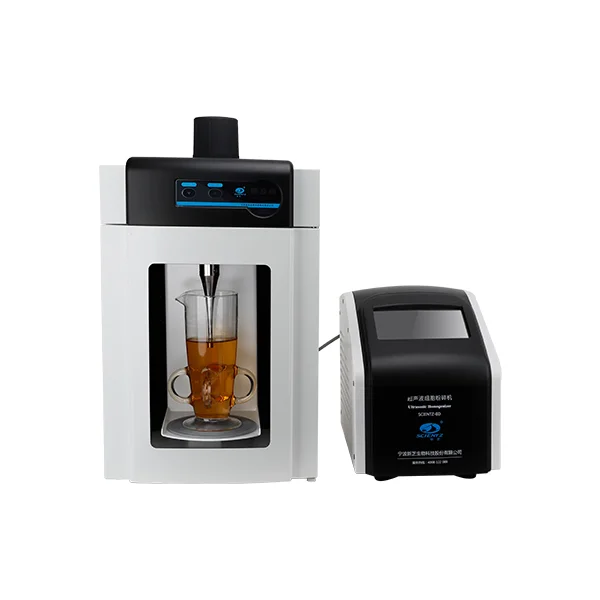
The core components of an ultrasonic homogenizer include:
-
Generator: Converts electrical energy into high-frequency electrical signals.
-
Transducer: Converts electrical signals into mechanical vibrations (ultrasound).
-
Horn (Probe): Amplifies the vibrations and transmits ultrasonic energy into the sample.
-
Sample Vessel: Contains the liquid or suspension being processed.
These components work together to create a high-energy environment capable of breaking down complex structures at the molecular or cellular level.
The Principle of Ultrasonication
The operation of ultrasonic homogenizers is based on the principle of acoustic cavitation. Cavitation is the formation, growth, and implosive collapse of tiny gas bubbles in a liquid when exposed to ultrasonic waves. When ultrasonic waves propagate through a liquid, they produce alternating high-pressure (compression) and low-pressure (rarefaction) cycles. During the low-pressure cycles, microscopic bubbles form in the liquid, which then collapse violently during the high-pressure cycles.
The implosion of these bubbles generates localized extreme conditions, including:
-
Temperatures of up to 5,000 Kelvin
-
Pressures exceeding 1,000 atmospheres
-
Shockwaves and micro-jets capable of disrupting particles and cell walls
This intense microenvironment is what makes ultrasonic homogenizers highly effective in cell disruption, particle size reduction, and emulsification.
How Ultrasonic Homogenizers Work
The working mechanism of an ultrasonic homogenizer can be described in several stages:
1. Generation of Ultrasonic Waves
The electrical generator produces a high-frequency alternating current, which is sent to the transducer. The transducer, often made of piezoelectric material, converts this electrical energy into mechanical vibrations at ultrasonic frequencies. These vibrations are then transmitted to the horn or probe, which amplifies the amplitude and directs it into the liquid sample.
2. Formation of Cavitation Bubbles
As the ultrasonic energy penetrates the liquid, it creates zones of high and low pressure. During the low-pressure phase, tiny cavities or bubbles form in the liquid. These bubbles are generally invisible to the naked eye but can range in size from a few nanometers to micrometers.
3. Bubble Collapse and Energy Release
During the high-pressure phase, the bubbles collapse violently. This collapse releases tremendous energy in the form of heat, pressure, and mechanical forces. The localized shockwaves and micro-jets created during cavitation are strong enough to:
-
Break cell walls and membranes
-
Fragment large particles into smaller ones
-
Mix immiscible liquids to form stable emulsions
4. Homogenization and Mixing
The combined effect of mechanical shear, cavitation-induced turbulence, and localized high energy results in homogenization. Ultrasonic homogenizers can achieve particle size reduction to the nanoscale, produce uniform dispersions, and enhance the extraction of intracellular components.
Applications of Ultrasonic Homogenizers
Ultrasonic homogenizers are versatile and used across multiple scientific and industrial fields. Some of the key applications include:
1. Cell Disruption and Extraction
In biological research, ultrasonic homogenizers are widely used for lysing cells to release intracellular proteins, DNA, RNA, or other biomolecules. The cavitation forces effectively break down the cell walls without the need for harsh chemicals, making the process suitable for sensitive biological samples.
2. Nanoparticle Synthesis
Nanotechnology heavily relies on ultrasonic homogenizers to produce nanoparticles with controlled size and morphology. Ultrasonication promotes uniform dispersion of nanoparticles in liquids, prevents aggregation, and can assist in chemical reactions that generate nanomaterials.
3. Emulsification
Ultrasonic homogenizers are highly effective in forming stable emulsions, especially for liquids that do not naturally mix, such as oil and water. This is particularly valuable in the food, cosmetic, and pharmaceutical industries, where consistent texture and stability are critical.
4. Degassing and Sample Preparation
Ultrasonication can remove dissolved gases from liquids, which is essential in applications like chromatography or precise chemical analysis. Additionally, ultrasonic homogenizers aid in dissolving powders and preparing uniform suspensions for experiments.
5. Food and Beverage Processing
In food technology, ultrasonic homogenizers improve texture, enhance flavor extraction, and extend shelf life. For example, sonication can be used to emulsify milk, juice, and sauces, ensuring smooth and stable products.
6. Pharmaceutical and Cosmetic Industry
Ultrasonic homogenizers facilitate the formulation of creams, lotions, and suspensions by achieving uniform particle distribution. They also enhance the extraction of bioactive compounds from plant materials for drugs and skincare products.
Advantages of Ultrasonic Homogenizers
Compared to traditional homogenization methods, ultrasonic homogenizers offer several benefits:
-
High Efficiency: Rapid processing times and fine particle size reduction.
-
Versatility: Suitable for a wide range of applications, from cell lysis to nanoparticle dispersion.
-
Non-Thermal Process: Unlike high-temperature methods, ultrasonication preserves heat-sensitive compounds.
-
Scalability: Available in bench-top units for laboratory use and large-scale industrial systems.
-
Precise Control: Adjustable frequency, amplitude, and processing time allow optimization for specific samples.
Considerations When Using Ultrasonic Homogenizers
While ultrasonic homogenizers are powerful, proper operation is crucial to avoid sample damage and ensure efficiency:
-
Amplitude and Duration: Excessive ultrasonic energy can overheat or degrade sensitive samples.
-
Temperature Control: Some samples require cooling during sonication to prevent thermal denaturation.
-
Probe Selection: The size and shape of the ultrasonic horn should match the volume and type of sample.
-
Maintenance: Regular cleaning of the probe and calibration of the generator are essential for consistent performance.
Conclusion
Ultrasonic homogenizers are sophisticated devices that harness the power of high-frequency sound waves and cavitation to achieve exceptional homogenization, particle size reduction, and cell disruption. Understanding the science behind their operation—especially the role of cavitation and ultrasonic waves—enables researchers and industrial operators to optimize their use for diverse applications. From biotechnology and pharmaceuticals to food processing and nanotechnology, ultrasonic homogenizers continue to play a critical role in modern science and industry, offering precision, efficiency, and versatility that traditional methods often cannot match.
By leveraging the principles of ultrasonic homogenization, laboratories and manufacturers can achieve higher consistency, improved extraction efficiency, and superior product quality, making these devices indispensable tools in both research and industrial production.
Scientz, as a professional manufacturer of ultrasonic homogenizers, is committed to providing high-performance and reliable ultrasonic processing equipment for fields such as scientific research, pharmaceuticals, food, and nanotechnology. With advanced acoustic design and precise control systems, Scientz products can efficiently achieve sample homogenization, cell disruption, emulsification, and nanoparticle dispersion, helping laboratory and industrial users improve research efficiency and product quality, and meet diverse application needs.
http://www.dscientz.com
dscientz -
-
AuthorPosts

- You must be logged in to reply to this topic.